Maths for Solar Panels
Solar panel maths answers one simple question:
How much electricity can we make from sunlight, and how do we estimate what a system will produce in the real world?
We’ll build up the maths slowly, using only what’s needed.
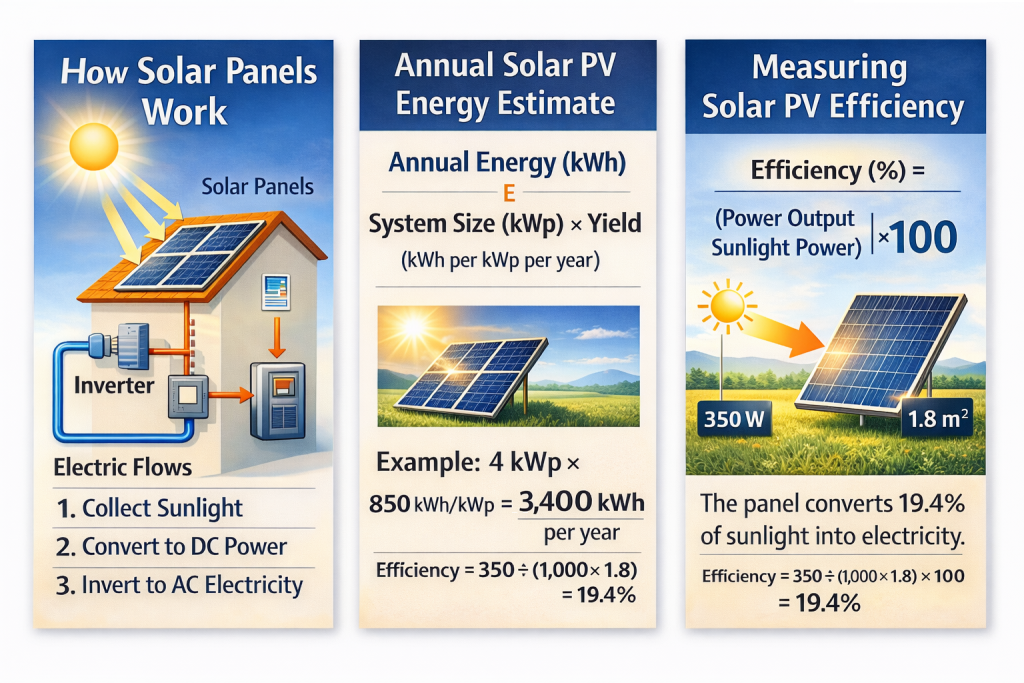
1. Sunlight Power (The Starting Point)
Solar panels rely on solar irradiance — that’s the power of sunlight hitting a surface.
Units
- Irradiance is measured in watts per square metre (W/m²).
- Example idea:
- 1,000 W/m² ≈ “strong midday sun” on a clear day (used as a test standard).
No maths yet — just measurement.
2. Power vs Energy (Very Important)
This shows up in every solar estimate.
Power (W or kW)
- How fast electricity is produced right now
Energy (Wh, kWh)
- How much electricity is produced over time
Key rule
Energy (kWh) = Power (kW) × Time (hours)
Example:
- If your system produces 2 kW for 3 hours:
Energy = 2 × 3 = 6 kWh
3. The “Rated Power” on a Solar Panel (STC)
Panel makers quote a “peak” power, usually written as Wp (watts peak).
This rating uses Standard Test Conditions (STC):
- 1,000 W/m² sunlight
- 25°C cell temperature
- A standard sunlight spectrum (often AM1.5)
So a 400 W panel means:
Under STC, that panel can produce 400 W.
In the real world, output changes because sunlight, temperature, and angle change.
4. The Simple Solar Power Equation
A useful “first-principles” equation is:
Panel power ≈ Sunlight (W/m²) × Panel area (m²) × Efficiency
So if:
- Sunlight = 700 W/m²
- Panel area = 1.8 m²
- Efficiency = 20% (0.20)
Then:
Power ≈ 700 × 1.8 × 0.20
Power ≈ 252 W
That’s why a “400 W” panel often produces less than 400 W: STC assumes very strong sun and ideal conditions.
5. System Size: kWp
When you put panels together, installers talk about kWp (kilowatt peak).
Example:
- 10 panels × 400 W each = 4,000 W
- That’s:
System size = 4,000 W = 4.0 kWp
Energy Saving Trust uses kWp as the “maximum power in ideal conditions” and notes typical home systems are around 3.5 kWp.
6. Annual Output: The Quick UK Estimate
A common way to estimate yearly electricity is:
Annual energy (kWh) ≈ System size (kWp) × Yield (kWh per kWp per year)
Energy Saving Trust gives example outputs for a 4.5 kWp system (around 2,850 kWh/year in their example calculator story).
Worked example (using that style)
If a system is 4.5 kWp and expected to generate 2,850 kWh/year:
You can estimate the “yield” as:
Yield ≈ 2,850 ÷ 4.5 ≈ 633 kWh per kWp per year
That number varies a lot by location, roof direction, shading, and weather — so treat it as an estimate, not a promise. MCS also warns that PV performance cannot be predicted with certainty because sunlight varies by location and year.
7. Performance Ratio (PR): A Simple Way to Include Losses
Even with good sunlight, a real system loses energy through things like:
- inverter conversion losses
- temperature losses (panels run hotter than 25°C)
- wiring losses
- dirt and shading
A simple way to “bundle” these losses is the Performance Ratio (PR).
Many sources treat a PR around 0.8 as typical for a well-designed system (about 80% of the ideal output after losses).
So you can think like this:
Real energy ≈ Ideal energy × PR
Example:
- If “ideal” model output = 3,500 kWh/year
- PR = 0.8
Then:
Real energy ≈ 3,500 × 0.8 = 2,800 kWh/year
8. Orientation and Tilt (The Angle Maths)
Solar panels work best when sunlight hits them more directly.
A simple rule is:
More direct sun → more power.
More “side-on” sun → less power.
In basic terms, the usable sunlight drops with angle (often modelled with a cosine relationship in engineering tools), which is why roof direction and tilt matter so much in real output estimates.
9. That’s All the Maths You Need
Every solar PV estimate comes back to:
- Sunlight strength (W/m²)
- System size (kWp)
- Time (hours → kWh)
- Losses (PR, shading, inverter, heat)
- Annual yield (kWh/year) — always an estimate
No advanced physics needed — just:
- multiplication
- division
- percentages
- and “kW × hours = kWh”