Maths for Solar Thermal
Solar thermal maths answers one simple question:
How much hot water heat can a solar thermal system produce from sunlight, and how do we estimate it through the year?
Solar thermal systems don’t make electricity. Instead, they collect heat and move it into a hot water tank. So the maths focuses on heat energy (kWh), collector area, sunlight, and losses.
1. Power vs Energy (Same Idea as Solar PV)
Two units matter most:
- kW (kilowatts) = heat power (how fast heat flows)
- kWh (kilowatt-hours) = heat energy (how much heat you collect over time)
Key rule:
Energy (kWh) = Power (kW) × Time (hours)
Example:
- If your system delivers 1.5 kW of heat for 2 hours:
Energy = 1.5 × 2 = 3 kWh
2. Sunlight on a Collector (The Input)
Solar thermal collectors rely on solar irradiance:
- Irradiance (G) measured in W/m²
- Collector size measured in m²
A simple “ideal heat in” calculation looks like:
Sun power hitting collector (W) = G (W/m²) × Area (m²)
Worked example
If sunlight is 600 W/m² and the collector area is 4 m²:
Power in = 600 × 4 = 2,400 W = 2.4 kW
That’s the sunlight power landing on the collector surface.
3. Collector Efficiency (Turning Sunlight into Useful Heat)
Collectors don’t turn all that sunlight into usable heat. They lose some to:
- reflection from glass
- heat leaking to outdoor air
- piping heat loss
So we use efficiency (η):
Useful heat power (kW) = G × Area × η
Worked example
Using the same values:
- G = 600 W/m²
- Area = 4 m²
- η = 50% (0.50)
Useful power = 600 × 4 × 0.50
Useful power = 1,200 W = 1.2 kW
So under those conditions, the system delivers about 1.2 kW of heat to the fluid.
Efficiency changes with:
- sunlight level
- outdoor temperature
- how hot the tank already is
Still, this equation gives a very useful first estimate.
4. Turning Heat into Daily Energy (kWh per day)
Now use the power-to-energy rule:
If the system averages 1.2 kW for 4 hours of good collection time:
Energy per day = 1.2 × 4 = 4.8 kWh/day
That daily heat goes into your hot water tank.
5. How Much Water Can That Heat?
This is the most practical solar thermal calculation:
How much hot water can I make?
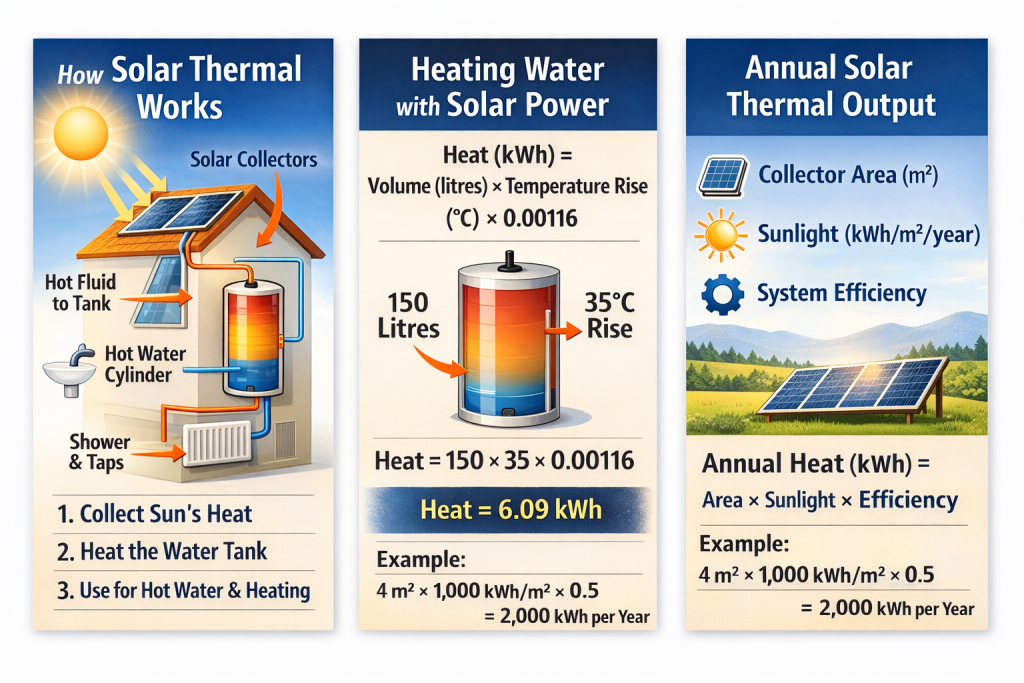
Water needs about 4.2 kJ to raise 1 kg by 1°C. A useful shortcut is:
To heat 1 litre of water by 1°C takes about 0.00116 kWh.
So:
Heat (kWh) ≈ Volume (litres) × Temperature rise (°C) × 0.00116
Worked example: heating a tank
Say you want to heat 150 litres of water by 35°C (e.g., from 15°C to 50°C):
Heat ≈ 150 × 35 × 0.00116
Heat ≈ 6.09 kWh
So you need about 6.1 kWh of heat to do that.
Now compare that to your solar thermal collection:
- If you collected 4.8 kWh in a day, you would heat most of that tank, but not all.
- On a sunnier day, you might cover it fully.
6. Solar Fraction (How Much You Cover)
Solar thermal systems usually supply a share of your hot water, not all of it year-round.
We can calculate the solar fraction:
Solar fraction (%) = (Solar heat delivered ÷ Total hot water heat needed) × 100
Worked example
If a home needs 2,000 kWh/year for hot water and solar thermal provides 1,000 kWh/year:
Solar fraction = (1,000 ÷ 2,000) × 100 = 50%
So solar thermal covers half of the annual hot water energy.
7. Annual Output: A Simple Estimate
A common way to estimate yearly solar thermal energy is:
Annual heat (kWh) ≈ Collector area (m²) × Annual solar energy on collector (kWh/m²) × System efficiency factor
Even without detailed weather data, the structure is clear:
- bigger area → more heat
- sunnier location → more heat
- higher losses or shading → less heat
That’s why two similar systems can perform very differently on different roofs.
8. Why Output Changes Through the Year
Solar thermal output changes because:
- Winter has fewer daylight hours and weaker sun
- Collectors lose more heat to cold air
- Tanks start colder, so the system “works harder”
- Summer can produce more heat than you need (so the system may stop collecting)
In other words:
Summer often gives lots of heat. Winter gives less. Spring and autumn sit in between.
9. That’s All the Maths You Need
Most solar thermal calculations use just:
- Sunlight × area to find heat input
- Efficiency to estimate useful heat
- kW × hours = kWh to get energy
- Water heating formula to link kWh to litres and temperatures
- Solar fraction to see how much hot water you cover
No advanced maths required — just multiplication, division, and a couple of helpful constants.