Why Energy Bills Are Higher Than They Need to Be
UK energy bills have risen sharply in recent years, squeezing household budgets and business costs. It isn’t one single cause. Several global and domestic factors interact, which can keep bills high even when headlines suggest wholesale prices are falling.
Quick take
UK prices are heavily influenced by global gas markets and by a system where gas often sets the wholesale electricity price. On top of that, reliance on imports, major infrastructure upgrades, and policy costs all feed into what households pay.
What’s driving high UK energy prices?
1) Global gas prices still high
Natural gas plays a central role in UK energy bills. Around 85% of UK homes use gas for heating, and gas often influences electricity prices too. When global gas prices rise, UK energy costs typically follow.
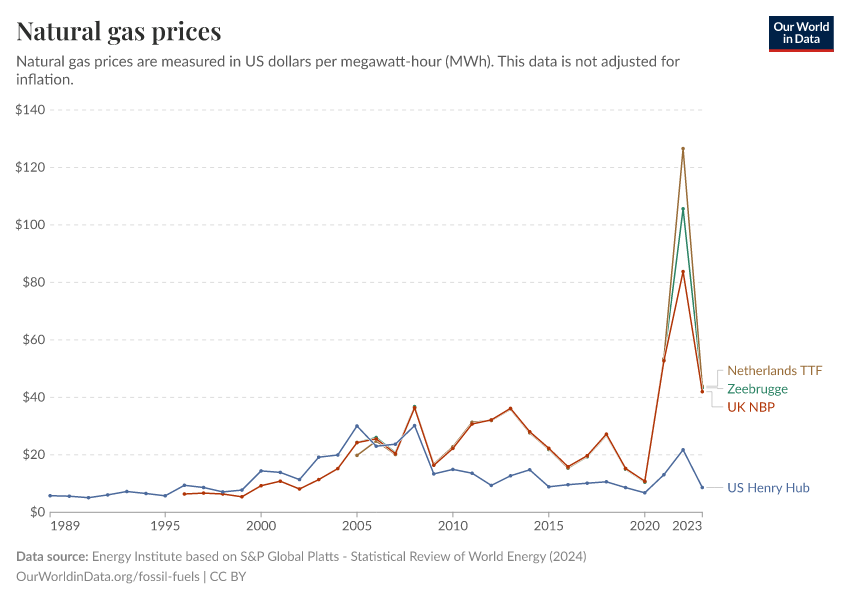
Prices surged after the pandemic due to strong worldwide demand, reduced supplies in Europe after Russia invaded Ukraine, and higher competition for liquefied natural gas (LNG). While wholesale gas prices have eased from their 2022 peak, they can remain above historical norms—keeping bills elevated.
Natural gas prices (chart):
https://ourworldindata.org/grapher/natural-gas-prices.png
2) Heavy dependence on imported energy
The UK now imports a large share of the energy it uses, including gas from countries such as the United States, Norway, and Qatar. This reliance exposes households and businesses to:
- Global price swings in international markets
- Currency effects (energy is often priced in US dollars)
- Volatile spot markets—especially when domestic production and storage are limited
Countries supplying UK imported gas in 2024 (chart):
https://apppack-app-naturalgasintel-prod-publics3bucket-8jv5bxjtvpgq.s3.amazonaws.com/images/uk-monthly-lng-imports-by-origin-.width-900.format-webp.webp

3) How electricity prices are determined
Even with growing renewable generation, UK electricity prices are often set by the marginal cost: the most expensive source needed to meet demand at that moment.
Because gas-fired plants frequently fill supply gaps (when demand is high or wind/solar output is lower), gas costs can set the wholesale electricity price much of the time. That means electricity can still look expensive even when wind and solar output is strong.
How marginal pricing works (illustration):
https://nuclear-economics.com/wp-content/uploads/2014/10/Commentary-2-figure-2-e1412194616929.jpg

4) Rising infrastructure and investment costs
The UK is investing heavily to improve reliability and energy security now and in the future. That includes modernising the grid, expanding renewable capacity, building storage and interconnectors, and maintaining existing gas and nuclear facilities. Many of these costs show up in bill components such as network charges.
Great Britain National Grid map:
https://upload.wikimedia.org/wikipedia/commons/e/ef/Map_of_the_National_Grid_in_Great_Britain.svg

5) Environmental and social policy costs
A portion of energy bills funds public policy goals, such as:
- Supporting vulnerable households
- Improving home energy efficiency
- Funding early renewable schemes
- Strengthening energy security
These levies help deliver real outcomes, but they add to bills and are often cited as a meaningful share of total costs.
Warm Home Discount graphic:
https://assets.publishing.service.gov.uk/media/62790e1ae90e070dbf5acaf2/s960_220509_Warm_home_discount.png
Home vs retrofit home infographic:
https://buildingenergyexperts.co.uk/wp-content/uploads/2024/07/Infrographics-Home-vs.-Retrofit-Home-2.1-e1637684078131-2048×1003-1.png

6) Renewables: part of the solution, not the problem
Some critics blame renewable energy for higher bills, but this is often misleading. Renewables can reduce reliance on gas and lower wholesale prices when supply is strong. However, renewables still require backup generation, storage, and grid upgrades to manage variability—costs that are reflected across the system.
7) The energy price cap and what it really means
Ofgem’s energy price cap limits the price per unit (and related charge limits), not the total bill. That means:
- Bills can rise if you use more energy
- The cap changes over time in line with wholesale costs
- Standing charges can still form a large share of what you pay
The cap helps reduce exposure to extreme spikes, but it can’t remove underlying cost pressures.
Energy price cap infographic:
https://cdn.statcdn.com/Infographic/images/normal/28131.jpeg

Why energy bills are higher than they need to be
High prices are only part of the story. Many households also pay more than necessary because energy is wasted quietly in the background—through heat loss, inefficient equipment, and systems running when they don’t need to.
The good news: most savings don’t require sacrifice. They come from stopping waste.
Focus on waste, not behaviour
The key idea is simple: you don’t need to change how you live—you only need to stop wasting energy.
That means:
- Heating the rooms you actually use
- Keeping heat from leaking outside
- Preventing appliances from running unnecessarily
- Making sure energy goes where it’s needed
A more efficient home feels smarter, not stricter.
Start with heating (the biggest part of most bills)
Use heating controls properly
Many homes have heating controls that are underused. Small adjustments can reduce costs quickly:
- Set the thermostat to a sensible temperature (often around 19–20°C for living areas)
- Use timers so heating runs only when you’re home
- Turn down radiators in unused rooms
These changes don’t have to make the home colder—they simply reduce unnecessary heating.
Keep heat where it belongs
Even a well-run heating system struggles if warmth escapes. Reduce heat loss by:
- Sealing gaps around doors and windows
- Using draught excluders
- Closing curtains at night
- Ensuring loft insulation is adequate
Keeping warmth in the home means the heating can run less often while comfort stays the same.
Check your boiler pressure
Many boilers operate outside their ideal pressure range without anyone noticing. When pressure is too low, the system can work harder to heat your home—using more gas while delivering less warmth.
Most modern boilers have a simple gauge. In many UK systems, ideal cold pressure is often around 1.0–1.5 bar.
If pressure drops, you may notice:
- Radiators heating unevenly
- Hot water taking longer
- The boiler cycling more often
Topping up using the filling loop usually takes only a few minutes. It’s a classic “no lifestyle change” saving: you don’t live differently, but the system runs more efficiently.
Cut electricity waste, not usage
Most people use electricity in similar ways—cooking, working, relaxing, entertainment. You don’t need to change any of that. Instead, target electricity that’s wasted in the background.
Tackle standby power
Many devices draw power even when they appear “off,” including:
- TVs
- Game consoles
- Set-top boxes
- Office equipment
Over a year, standby consumption can add up. Practical fixes:
- Use extension leads with switches
- Turn off groups of devices together
- Unplug chargers when not in use
You still use everything as normal—you just stop paying for it while it’s idle.
Make your home work smarter
A “smart home” doesn’t have to be expensive. It can simply mean using basic tools that reduce waste automatically, such as:
- Programmable thermostats
- Smart plugs for high-usage devices
- Timer switches for immersion heaters
- Motion-sensor lighting in low-use areas
These operate in the background, so savings happen without constant effort.
Replace inefficient equipment gradually
Old appliances can cost far more to run than people expect, but replacing everything at once isn’t realistic. A practical approach:
- Replace appliances when they fail
- Choose efficient models when you do
- Prioritise items that run constantly (like fridges and freezers)
Over time, your home becomes more efficient with minimal disruption.
Understand your energy tariff
Sometimes the biggest savings come from pricing, not usage. Check:
- Whether you’re on a standard variable tariff
- Your unit rates and standing charges
- Available deals (compare carefully)
Switching tariff doesn’t change how you live—but it can reduce the cost of every unit you use.
Small improvements that add up
Each improvement may feel minor on its own, but together they can make a real difference:
- Better insulation reduces heating demand
- Smarter controls prevent wasted heat
- Efficient appliances reduce electricity consumption
- Reduced standby power cuts silent losses
Over a year, these can add up to substantial savings—often without noticeable lifestyle change.
Conclusion
UK energy prices are high due to global gas markets, imported energy exposure, electricity pricing mechanisms, infrastructure investment, and policy costs. But even within that reality, many households pay more than necessary because their homes waste energy.
Cutting bills doesn’t require sacrifice. The most effective changes happen in the background: reduce heat loss, optimise heating controls, eliminate standby power, maintain key systems (like boiler pressure), and make smart upgrades over time. Comfort stays at home—while waste steadily disappears.