How Much Electricity Do Appliances Use?

A Simple Guide to Watts, Kilowatts, kWh and Running Costs

Every electrical appliance uses energy.

However, understanding how much it uses can seem confusing.

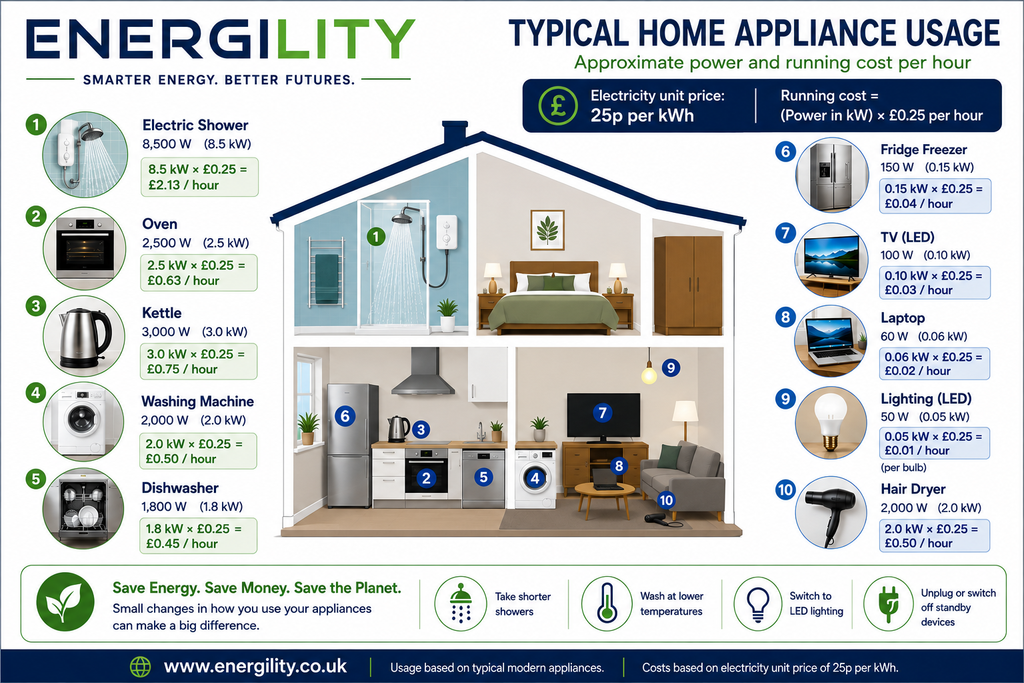
A kettle may say 3,000 watts, while a television might use only 100 watts. At first, you might assume the kettle must cost far more to use.

But power is only part of the story.

The kettle may run for just a few minutes, while the television could stay on for several hours.

So, to understand electricity use, you need to consider both power and time.

Power tells you how fast energy is being used. Time tells you how much you actually use.

Once you understand this, appliance running costs become much easier to work out.

What Is a Watt?

A watt, shown as W, is a measure of power.

It tells you the rate at which an appliance can use energy.

For example:

  • LED light bulb — 8 W
  • Television — 100 W
  • Microwave — 1,000 W
  • Electric heater — 2,000 W
  • Kettle — 3,000 W

These are only examples. Actual appliances vary.

A higher wattage means the appliance can use energy at a faster rate.

However, that does not automatically mean it will cost more over the day.

You also need to know how long it runs.

What Is a Kilowatt?

A kilowatt, shown as kW, is simply 1,000 watts.

Therefore:

1,000 W = 1 kW

2,000 W = 2 kW

3,000 W = 3 kW

Dividing watts by 1,000 converts them into kilowatts.

For example:

500 W ÷ 1,000 = 0.5 kW

Electricity bills are based on kilowatt-hours, so converting watts into kilowatts makes running-cost calculations easier.

What Is a Kilowatt-Hour?

A kilowatt-hour, shown as kWh, measures energy used over time.

This is the unit your electricity supplier uses when charging you for the electricity you consume.

For example, an appliance drawing 1 kW continuously for one hour would use:

1 kWh

A 2 kW appliance running continuously for one hour would use:

2 kW × 1 hour = 2 kWh

Meanwhile, a 500 W appliance is 0.5 kW.

If it runs continuously for two hours:

0.5 kW × 2 hours = 1 kWh

So, different combinations of power and time can result in the same amount of energy being used.

The Basic Calculation

The calculation is:

Energy used = Power in kW × Time in hours

Once you know the energy used, you can estimate the cost:

Cost = Energy used in kWh × Electricity unit rate

For example, suppose your electricity costs 25p per kWh.

A 2 kW heater running continuously at full power for one hour would use:

2 kW × 1 hour = 2 kWh

The cost would therefore be:

2 kWh × £0.25 = £0.50

So, in this example, one hour would cost 50p.

How to Convert Minutes Into Hours

Appliances do not always run for complete hours.

Therefore, you may need to convert minutes into part of an hour.

The calculation is:

Minutes ÷ 60 = Hours

For example:

30 minutes ÷ 60 = 0.5 hours

15 minutes ÷ 60 = 0.25 hours

6 minutes ÷ 60 = 0.1 hours

Once you have converted the time, you can use the normal calculation.

Example: A 3 kW Kettle

Imagine a 3 kW kettle takes three minutes to boil.

First, convert three minutes into hours:

3 ÷ 60 = 0.05 hours

Then calculate the energy:

3 kW × 0.05 hours = 0.15 kWh

At 25p per kWh:

0.15 × £0.25 = £0.0375

So, in this example, boiling the kettle would cost about:

3.8p

Although the kettle uses a lot of power, it only runs for a short time.

That makes an important point:

High power does not necessarily mean high cost.

Example: A 100 W Television

Now imagine a television uses 100 W while it is operating.

First, convert watts to kilowatts:

100 W ÷ 1,000 = 0.1 kW

If the television runs for four hours:

0.1 kW × 4 hours = 0.4 kWh

At 25p per kWh:

0.4 × £0.25 = £0.10

So, in this example, four hours of television use costs around 10p.

The television uses far less power than the kettle, but it runs for much longer.

Example: A Small Device Running All Day

Small amounts of power can also add up when something runs continuously.

Suppose a device draws 10 W.

That is:

10 W ÷ 1,000 = 0.01 kW

If it runs for 24 hours:

0.01 kW × 24 = 0.24 kWh

At 25p per kWh:

0.24 × £0.25 = £0.06

That is about 6p per day.

Over 365 days:

£0.06 × 365 = £21.90

So, even a relatively small load can become noticeable if it operates continuously throughout the year.

Why Wattage Does Not Always Equal Actual Use

The power rating on an appliance can be useful.

However, it does not always mean the appliance draws that amount of power continuously.

Many appliances switch components on and off or change their power while operating.

Examples include:

  • Fridges
  • Freezers
  • Ovens
  • Electric heaters
  • Washing machines
  • Dishwashers
  • Tumble dryers
  • Heat pumps

Therefore, multiplying the maximum rated power by every hour the appliance is switched on can sometimes greatly overestimate actual electricity use.

Electric Heaters and Thermostats

Consider a 2 kW electric heater.

If the heating element stays on continuously for one hour, it uses:

2 kWh

However, a thermostatically controlled heater may switch the heating element off once the room reaches the required temperature.

It then switches back on when more heat is needed.

So, a heater switched on for four hours does not necessarily consume:

2 kW × 4 hours = 8 kWh

That would only apply if it actually drew 2 kW continuously for the whole four hours.

The real consumption depends on how long the heating element operates.

Fridges and Freezers

A fridge may be switched on 24 hours a day.

However, its compressor does not normally run continuously.

Instead, the appliance cools the interior and then switches the compressor off until more cooling is needed.

Actual consumption can depend on:

  • Room temperature
  • Temperature setting
  • Appliance efficiency
  • Door opening
  • Amount of food stored
  • Condition of the seals
  • Ventilation around the appliance

Therefore, annual kWh figures on the energy label are usually more useful for comparing fridges than simply looking at their wattage.

Learn more about Understanding Energy Labels →

Washing Machines

A washing machine’s electricity use changes throughout a wash.

It may use electricity for:

  • Heating water
  • Turning the drum
  • Pumping water
  • Spinning
  • Controls

The heater can use a relatively high amount of power.

However, it does not necessarily operate throughout the complete programme.

This is why a two-hour wash should not simply be calculated by multiplying the machine’s maximum wattage by two hours.

Programme choice matters too.

For example, lower-temperature and Eco programmes can reduce the energy needed to heat water.

Dishwashers

Dishwashers behave in a similar way.

Electricity may be used for:

  • Heating water
  • Pumps
  • Drying
  • Controls

Again, the heating element does not necessarily operate continuously throughout the entire programme.

Therefore, programme energy consumption is more useful than maximum wattage when estimating the cost of a complete cycle.

Ovens

An electric oven uses significant power while heating.

Once it reaches the selected temperature, however, the heating elements normally cycle on and off.

As a result, a 2.5 kW oven switched on for two hours does not necessarily use exactly 5 kWh.

Actual consumption depends on factors such as:

  • Temperature
  • Preheating
  • Cooking time
  • How often the door is opened
  • Oven design
  • Amount of food being cooked

So, rated power gives you useful information, but it is not always the same as average power throughout cooking.

Tumble Dryers

Tumble dryers can be significant electricity users.

However, consumption varies greatly between different designs.

For example, heat-pump tumble dryers operate differently from traditional resistance-heated dryers.

Cycle length can also be misleading.

A heat-pump dryer may take longer to dry clothes while still using less electricity overall.

Therefore:

Longer running time does not automatically mean higher energy use.

Power and time need to be considered together.

Kettles

A kettle is a good example of a high-power appliance that operates briefly.

The amount of electricity needed also depends on how much water you heat.

Boiling enough water for one or two drinks requires less energy than repeatedly boiling a full kettle unnecessarily.

Therefore, one of the easiest ways to reduce kettle energy use is:

Boil only the water you need.

Microwaves

Microwaves can use relatively high power while running.

However, they often heat food quickly.

For smaller portions, this can make them cheaper to use than heating a large conventional oven.

Still, check the actual appliance and cooking time rather than assuming one method is always cheapest.

Air Fryers

Air fryers can also use fairly high power.

However, their smaller cooking chamber means they can heat quickly.

For small amounts of food, this may reduce overall electricity use compared with a large oven.

On the other hand, running several batches may reduce that advantage.

Again:

Look at the whole cooking job, not just the wattage.

Slow Cookers

Slow cookers demonstrate the opposite effect.

They normally use much less power than an oven but operate for several hours.

For example, suppose a slow cooker averages 200 W while operating.

That is:

0.2 kW

If it operated at that average power for six hours:

0.2 kW × 6 = 1.2 kWh

At 25p per kWh:

1.2 × £0.25 = £0.30

So, the example cost would be around 30p.

However, actual appliance consumption can vary.

Hair Dryers

Hair dryers can have surprisingly high power ratings.

A 2 kW hair dryer sounds expensive to run.

However, suppose it is used for six minutes.

Six minutes is:

6 ÷ 60 = 0.1 hours

Therefore:

2 kW × 0.1 = 0.2 kWh

At 25p per kWh:

0.2 × £0.25 = £0.05

So, the example cost is about 5p.

Once again, high power does not necessarily mean high daily cost when the appliance runs briefly.

Electric Showers

Electric showers are among the higher-powered appliances found in many homes.

Unlike a shower using stored hot water, an electric shower heats cold water as it flows through the unit.

Therefore, power ratings can be several kilowatts.

Imagine a 9 kW shower operating at full power for ten minutes.

Ten minutes is:

10 ÷ 60 = 0.167 hours

So:

9 kW × 0.167 ≈ 1.5 kWh

At 25p per kWh:

1.5 × £0.25 = £0.375

That is about 38p for this example shower.

However, actual consumption depends on the shower, power setting, water flow and time used.

Immersion Heaters

An immersion heater uses electricity to heat water stored in a cylinder.

A common immersion heater may be rated around 3 kW.

If a 3 kW element operated continuously for one hour:

3 kW × 1 hour = 3 kWh

At 25p per kWh:

3 × £0.25 = £0.75

However, the thermostat switches the element off once the water reaches the required temperature.

Therefore, leaving an immersion heater switched on does not necessarily mean it continuously draws 3 kW.

Even so, heat is gradually lost from the cylinder and may need to be replaced.

Good cylinder insulation therefore matters.

Common Appliance Power Examples

The figures below are illustrative only.

Actual power varies by appliance, model and operating mode.

ApplianceExample power
LED bulb5–15 W
Wi-Fi router5–20 W
Laptop30–100 W
Television50–200 W
Slow cooker100–300 W
Fridge/freezerVaries during operation
Games console50–250+ W
Washing machineVaries during cycle
DishwasherVaries during cycle
Microwave700–1,500+ W
Air fryer1,000–2,000+ W
Hair dryer1,000–2,400+ W
Electric heater1,000–3,000 W
Kettle2,000–3,000 W
Immersion heaterOften around 3,000 W
Electric showerSeveral thousand watts

Do not use this table as the exact rating for your appliance.

Instead, check the appliance itself, its manual or its energy information where available.

How Much Does One Hour Cost?

For an appliance drawing a steady amount of power, the calculation is straightforward.

Using an example electricity price of 25p per kWh:

Continuous powerEnergy in one hourExample cost
10 W0.01 kWh0.25p
100 W0.1 kWh2.5p
500 W0.5 kWh12.5p
1 kW1 kWh25p
2 kW2 kWh50p
3 kW3 kWh75p

Again, this assumes the appliance draws that power continuously for the full hour.

Many real appliances do not.

Use Your Own Electricity Price

The examples above use 25p per kWh simply because it makes the calculations easy to follow.

Your electricity price may be different.

Check your energy bill, online account or supplier app for your current unit rate.

Then use:

kWh used × your unit rate = estimated cost

For example, if you pay 28p per kWh and an appliance uses 1.5 kWh:

1.5 × £0.28 = £0.42

The estimated cost is 42p.

Don’t Add the Standing Charge

Your electricity bill may also include a daily standing charge.

However, you do not normally add the standing charge when calculating the running cost of one appliance.

You pay that charge for having the electricity supply available.

Therefore, appliance calculations normally use the unit rate per kWh.

How Can You Find an Appliance’s Wattage?

Look for a rating label on the appliance.

Depending on the product, this may be:

  • On the back
  • Underneath
  • Inside a door
  • Near the power cable
  • In the manual

You may also find the information in the manufacturer’s specifications.

Look for W or kW.

However, remember that the rating may show maximum or rated power rather than the appliance’s average consumption.

What If the Label Shows Volts and Amps?

Sometimes a device may show voltage and current rather than an obvious wattage.

You may see:

230 V

and

2 A

A simple power calculation is:

Watts ≈ Volts × Amps

So:

230 × 2 = 460 W

However, this simple calculation is not exact for every type of AC electrical load because factors such as power factor can matter.

For normal household cost estimates, it can provide a rough indication where suitable.

If actual wattage or measured energy use is available, use that instead.

Use a Plug-In Energy Monitor

For many plug-in appliances, an energy monitor can provide a better picture of actual consumption.

The device sits between the wall socket and appliance.

Depending on the monitor, it may show:

  • Current power
  • kWh used
  • Running time
  • Estimated cost

This can be particularly useful for appliances whose consumption changes over time.

For example, you could measure a television over an evening or a fridge over several days.

A longer measurement usually gives a better picture for appliances that cycle on and off.

Smart Plugs Can Also Help

Some smart plugs include energy monitoring.

Using a phone app, you may be able to see:

  • Current power
  • Daily consumption
  • Weekly consumption
  • Historical use

This can make it easier to find devices using more electricity than expected.

However, not every smart plug measures energy.

Check the specification before buying one for this purpose.

Also, make sure any plug or monitor is suitable for the appliance’s electrical load.

Use Your Smart Meter

A smart meter can also help you understand household electricity use.

Your in-home display or supplier app may show current or recent consumption.

For example, you might notice the household demand increase when you switch on a kettle or electric heater.

However, the smart meter normally measures the whole property’s electricity use.

Therefore, other devices may also be operating at the same time.

It is useful for spotting patterns, but it does not necessarily isolate one appliance.

Measure Instead of Guessing

Estimates are useful when comparing appliances.

However, actual measurement can be even better.

If you want to know what something really costs in your home, try to find:

  1. How much energy it actually uses
  2. How long you use it
  3. Your electricity unit rate

Then calculate the cost.

This is especially useful for appliances that operate differently from their maximum power rating.

Focus on the Big Users First

It is easy to worry about every charger and standby light in the house.

However, start with the appliances that are most likely to make a meaningful difference.

Depending on your home, these may include:

  • Electric space heating
  • Electric hot water
  • Electric showers
  • Tumble dryers
  • Cooking appliances
  • Frequently used washing equipment

Then consider appliances that operate for long periods, such as refrigeration and home entertainment equipment.

After that, investigate the smaller loads if you want to go further.

Don’t spend hours chasing pennies while ignoring pounds.

Power and Energy Are Not the Same

This distinction is worth remembering.

Power tells you the rate of energy use.

It is measured in watts or kilowatts.

Energy tells you how much has actually been used over time.

It is measured in kilowatt-hours.

Your electricity supplier charges you mainly for the energy you consume.

Therefore, knowing an appliance’s wattage is only the beginning.

A Simple Formula to Remember

For most basic appliance calculations, you only need three steps.

1. Convert watts to kilowatts

Watts ÷ 1,000 = kW

2. Calculate energy use

kW × hours = kWh

3. Calculate cost

kWh × unit rate = cost

For example:

A 500 W appliance runs for three hours.

500 ÷ 1,000 = 0.5 kW

Then:

0.5 × 3 = 1.5 kWh

At 25p per kWh:

1.5 × £0.25 = £0.375

So, the example cost is about:

38p

In Short

Understanding appliance electricity use becomes much easier once you separate power from energy.

Watts and kilowatts tell you how quickly an appliance can use energy.

Kilowatt-hours tell you how much energy it actually uses over time.

Then your electricity unit rate tells you what that energy costs.

So, remember:

Power × Time = Energy

and:

Energy × Unit Rate = Cost

However, do not assume an appliance continuously uses the wattage printed on its label. Thermostats, heating elements, compressors and electronic controls can all change consumption while it operates.

Where possible, use actual energy figures or measure the appliance over a realistic period.

Most importantly:

High power does not necessarily mean high cost.

A powerful appliance used for a few minutes may consume less electricity than a low-power appliance running all day.

Once you understand power, time and kWh, you can stop guessing and start working out where your electricity is really going.

Energility

Understand More. Spend Less. Live Better.