
Most energy tariffs have two main charges: a unit rate and a standing charge. Together, they help decide how much you pay for gas and electricity.
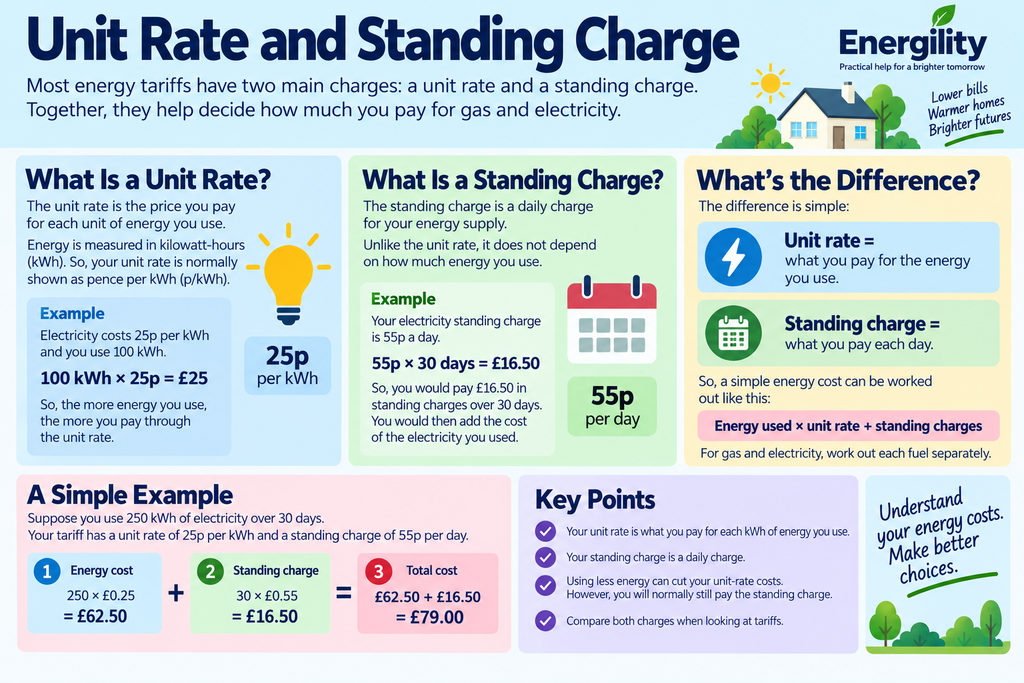
What Is a Unit Rate?
The unit rate is the price you pay for each unit of energy you use.
Energy is measured in kilowatt-hours, or kWh. So, your unit rate is normally shown as pence per kWh (p/kWh).
For example, if electricity costs 25p per kWh and you use 100 kWh:
100 kWh × 25p = £25
So, the more energy you use, the more you pay through the unit rate.
Gas and electricity normally have different unit rates.
What Is a Standing Charge?
The standing charge is a daily charge for your energy supply.
Unlike the unit rate, it does not depend on how much energy you use.
For example, if your electricity standing charge is 55p a day:
55p × 30 days = £16.50
So, you would pay £16.50 in standing charges over 30 days. You would then add the cost of the electricity you used.
Gas and electricity normally have separate standing charges.
What’s the Difference?
The difference is simple:
Unit rate = what you pay for the energy you use.
Standing charge = what you pay each day.
So, a simple energy cost can be worked out like this:
Energy used × unit rate + standing charges
For gas and electricity, work out each fuel separately.
A Simple Example
Suppose you use 250 kWh of electricity over 30 days.
Your tariff has:
- a unit rate of 25p per kWh
- a standing charge of 55p per day
First, work out the energy cost:
250 × £0.25 = £62.50
Then, work out the standing charge:
30 × £0.55 = £16.50
Finally, add them together:
£62.50 + £16.50 = £79.00
So, the estimated electricity cost is £79.00.
These rates are examples only.
Why Unit Rates Matter
If you use a lot of energy, the unit rate can have a big effect on your bill.
For example, a small difference in the price per kWh can add up over a year.
So, when you compare tariffs, don’t look at the standing charge alone.
Why Standing Charges Matter
Standing charges can be more noticeable if you use very little energy.
For example, a standing charge of 55p a day adds up to:
£200.75 a year
You would pay this before adding the cost of the energy you use.
So, using less energy can cut the unit-rate part of your bill. However, it does not normally remove the standing charge.
What If You Use No Energy?
You will normally still pay the standing charge.
So, an empty or rarely used home may still have an energy bill.
However, tariffs can differ. Therefore, check the terms of your own tariff.
Are Charges the Same Everywhere?
No. Your rates can depend on several things, including:
- your supplier
- your tariff
- where you live
- how you pay
- your meter and tariff type
Therefore, don’t assume that an average rate shown online is the rate you pay.
Instead, check your energy bill, supplier account or app.
What About the Price Cap?
The Energy Price Cap can limit unit rates and standing charges for tariffs covered by it.
However, it does not set a limit on your total energy bill.
Your bill still depends on how much energy you use.
Learn more: Energy Price Cap →
Compare Both Charges
When you compare tariffs, look at both the unit rate and standing charge.
For example, one tariff may have a lower unit rate but a higher standing charge. Another may have a higher unit rate but a lower standing charge.
So, neither tariff is always cheaper.
Instead, use your own yearly energy use to work out the likely total cost.
Find Your Charges
You can normally find your unit rates and standing charges on your energy bill, supplier account or app.
Look for:
Unit rate: pence per kWh (p/kWh)
Standing charge: pence per day (p/day)
If you have both gas and electricity, check each one separately.
Key Points
Your unit rate is what you pay for each kWh of energy you use.
Your standing charge is a daily charge.
So, using less energy can cut your unit-rate costs. However, you will normally still pay the standing charge.
Most importantly, compare both charges when looking at tariffs.
Important Information
Energility provides general information to help you understand energy, household and business costs, services and ways to save money. It is not financial, legal, tax, technical or professional advice.
Prices, tariffs, grants, government schemes, regulations and other information can change. Costs, savings and calculator results are estimates and your actual results may be different.
Before making an important financial decision, signing a contract or carrying out significant work, check the latest information and consider getting advice from a suitably qualified professional where needed.
Energility may receive a commission or other benefit from some links or services. Where this applies, we aim to make it clear. This does not increase the price you pay unless stated otherwise.
Energility
Learn. Compare. Save.