
A Practical Guide to Comparing Tariffs Using Your Own Energy Use
Once you understand the different types of energy tariff, the next step is comparing the actual deals available to you.
The important thing is not simply to find the lowest unit rate.
Different tariffs can have different:
- Unit rates
- Standing charges
- Exit fees
- Contract terms
The best way to compare them is to use your own energy consumption and work out what each tariff could cost you.
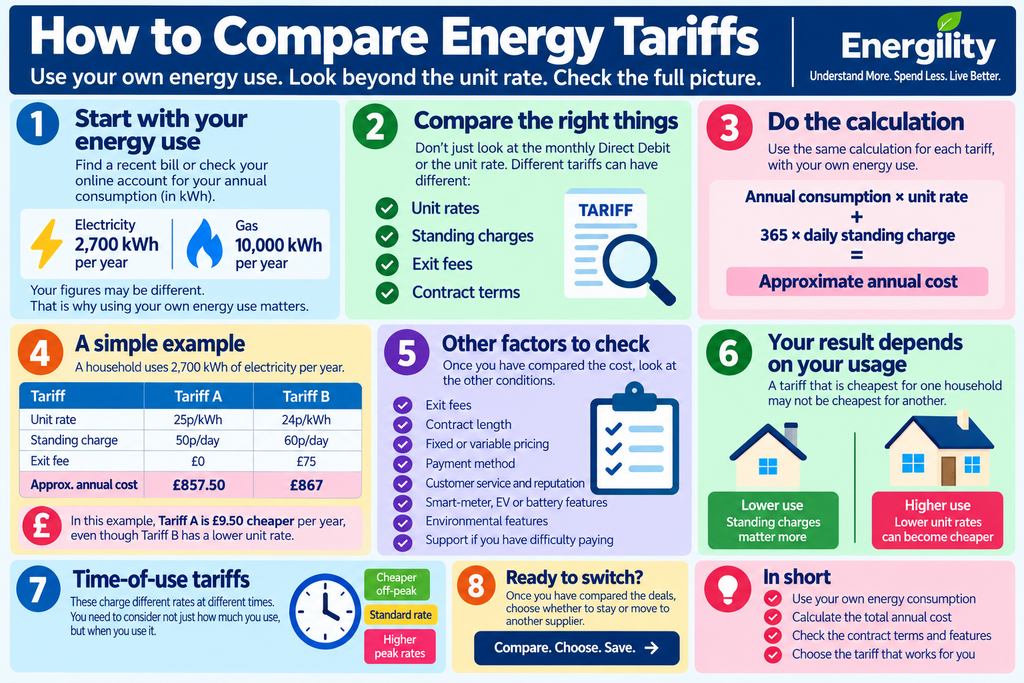
Start With Your Annual Energy Use
Find a recent energy bill or look at your online energy account.
You are looking for your annual consumption in kilowatt-hours (kWh).
For example:
Electricity: 2,700 kWh per year
Gas: 10,000 kWh per year
Your figures may be very different.
That is exactly why using your own consumption matters.
Learn how to understand your energy bill →
Don’t Compare Monthly Direct Debits
Suppose one supplier suggests a Direct Debit of £120 per month and another suggests £130.
That does not necessarily mean the first tariff is cheaper.
A Direct Debit is a payment arrangement.
To compare the underlying tariffs, look instead at the unit rates and standing charges and apply them to your own energy consumption.
A Simple Worked Example
Imagine a household uses:
2,700 kWh of electricity per year
It is considering two electricity tariffs.
| Tariff A | Tariff B | |
|---|---|---|
| Unit rate | 25p/kWh | 24p/kWh |
| Standing charge | 50p/day | 60p/day |
| Exit fee | £0 | £75 |
At first glance, Tariff B might look cheaper because it has the lower unit rate.
But let’s calculate the approximate annual cost.
Tariff A
First calculate the energy used:
2,700 kWh × £0.25 = £675
Then calculate the annual standing charge:
365 × £0.50 = £182.50
Add them together:
£675 + £182.50 = £857.50
So the approximate annual cost is:
Tariff A: £857.50
Tariff B
Now do the same calculation.
Energy used:
2,700 kWh × £0.24 = £648
Annual standing charge:
365 × £0.60 = £219
Add them together:
£648 + £219 = £867
So the approximate annual cost is:
Tariff B: £867
Which Tariff Is Cheaper?
In this example:
Tariff A: £857.50
Tariff B: £867
Tariff A is approximately:
£9.50 cheaper per year
That may be surprising.
Tariff B had the lower unit rate, but its higher standing charge outweighed the saving for this particular household.
And Tariff B also has a £75 exit fee, while Tariff A has none.
This is why you should never compare energy tariffs using one figure alone.
Use the Same Calculation With Your Own Energy Use
For a straightforward single-rate tariff, the basic calculation is:
Annual consumption × unit rate
plus
365 × daily standing charge
This gives you an approximate annual cost based on that level of consumption.
Remember to convert pence into pounds when doing the calculation.
For example:
25p = £0.25
and:
60p = £0.60
If You Have Gas and Electricity
Calculate the two fuels separately.
For electricity:
Electricity consumption × electricity unit rate
plus
365 × electricity standing charge
Then do the same for gas:
Gas consumption × gas unit rate
plus
365 × gas standing charge
Finally:
Electricity cost + gas cost = approximate combined annual cost
This also means you can compare separate gas and electricity suppliers with a dual-fuel option rather than assuming both fuels have to stay together.
Your Energy Use Can Change Which Tariff Wins
This is an important point.
In our example, Tariff A was cheaper for someone using 2,700 kWh per year.
But that does not mean Tariff A would always be cheaper.
Because Tariff B has a lower unit rate but a higher standing charge, a household using considerably more electricity could eventually reach a point where Tariff B becomes cheaper.
Conversely, someone using very little electricity may be affected more strongly by the standing charge.
So there isn’t necessarily one cheapest tariff for everyone.
What matters is:
What would this tariff cost based on the way I use energy?
The Calculation Is Only the Starting Point
Once you have compared the approximate annual cost, look at the other conditions.
Check:
- Exit fees
- Contract length
- Fixed or variable pricing
- Payment method
- Any discounts or special conditions
- What happens when the tariff ends
A tariff that is £10 cheaper over a year but has a large exit fee may not necessarily be the better choice for you.
Likewise, you may decide that greater flexibility is worth paying slightly more for.
Time-of-Use Tariffs Need a Different Comparison
The simple calculation above works well for straightforward tariffs with one unit rate.
A time-of-use tariff is different because electricity can cost different amounts at different times.
You therefore need to know not only:
How much electricity do I use?
but also:
When do I use it?
For example, a tariff with very cheap overnight electricity could work well if you regularly charge an EV or home battery overnight.
However, it may be less attractive if most of your electricity is used during expensive peak periods.
Learn about fixed, variable and smart tariffs →
Price Isn’t Everything
Once two tariffs are reasonably close in price, other factors may influence your decision.
You might consider:
- Customer service
- Billing
- Supplier reputation
- App and online-account features
- Smart-meter support
- EV charging features
- Battery integration
- Environmental features
- Support available if you have difficulty paying
There is nothing wrong with paying slightly more for something you value.
The important thing is to understand what the difference costs you.
A Simple Comparison Checklist
Before choosing a tariff, check:
- Your annual gas and electricity consumption
- The unit rates
- The standing charges
- The approximate annual cost using your consumption
- Any exit fees
- The contract length
- Whether prices are fixed or variable
- Whether different rates apply at different times
- Any important conditions or features
- Whether the tariff actually suits the way you use energy
Then make your decision based on the whole picture.
Ready to Switch?
Once you have compared the deals and chosen an option, you can decide whether to stay with your existing supplier or move to another one.
Learn how to switch energy supplier →
Our energy comparison and switching service is coming soon.
In Short
Don’t compare energy tariffs using the monthly Direct Debit or the unit rate alone.
Use your own annual consumption.
Calculate:
Energy used × unit rate
then add:
Daily standing charge × 365
Do this for each tariff using exactly the same consumption figures.
Then compare the contract terms, exit fees and any features that matter to you.
That turns an energy comparison from:
“Which tariff looks cheaper?”
into the much more useful question:
“Which tariff works out better for me?”
Important Information
Energility provides general information to help you understand energy, household and business costs, services and ways to save money. It is not financial, legal, tax, technical or professional advice.
Prices, tariffs, grants, government schemes, regulations and other information can change. Costs, savings and calculator results are estimates and your actual results may be different.
Before making an important financial decision, signing a contract or carrying out significant work, check the latest information and consider getting advice from a suitably qualified professional where needed.
Energility may receive a commission or other benefit from some links or services. Where this applies, we aim to make it clear. This does not increase the price you pay unless stated otherwise.
Energility
Learn. Compare. Save.