
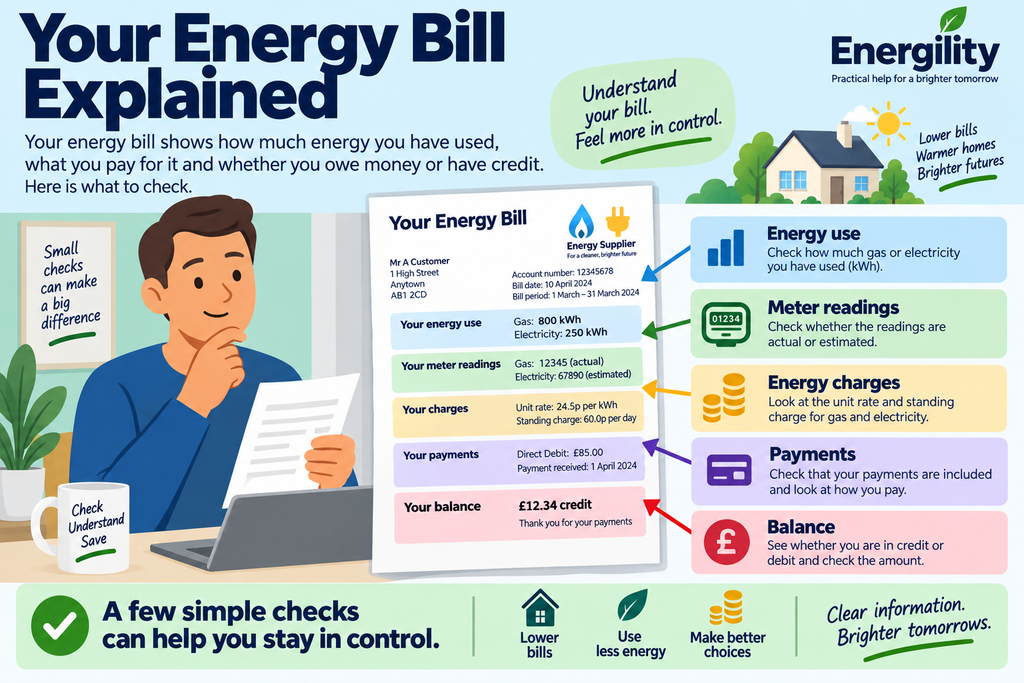
Your energy bill shows how much energy you have used, what you pay for it and whether you owe money or have credit. Here is what to check.
Start With Your Bill
Energy bills can look confusing at first. However, most contain the same key information.
Start by finding:
- your energy use
- your meter readings
- your unit rates
- your standing charges
- the dates covered
- payments you have made
- your account balance
- your tariff
Once you know where these are, your bill becomes much easier to follow.
Check Your Energy Use
Your bill shows how much gas or electricity you have used.
Energy use is normally shown in kilowatt-hours, or kWh.
In simple terms, the more energy you use, the more you will normally pay.
However, don’t look at the cost alone. Also, compare your energy use with earlier bills.
If your use has gone up, ask what has changed.
For example, you may have used more heating, hot water or electrical appliances.
Check Your Meter Readings
Next, look at the meter readings on your bill.
Check whether they are actual or estimated.
An actual reading is based on a meter reading provided by you, your supplier or your smart meter.
However, an estimated reading is an estimate of how much energy you may have used.
So, if your bill seems too high or too low, check the reading against your meter.
If the figures are very different, contact your supplier.
Check Your Energy Charges
Your bill should show your unit rate and standing charge.
The unit rate is the price you pay for each kWh of energy you use.
The standing charge is a daily charge. So, you will normally pay it even on days when you use little or no energy.
Gas and electricity normally have their own rates.
Learn more: Energy Charges Explained →
Check the Bill Dates
Next, check the dates covered by the bill.
This matters because a larger bill may simply cover a longer period.
Also, compare the dates with your last bill. This can help you spot gaps or charges that cover an earlier period.
Check Your Payments
Now check the payments shown on your account.
Make sure payments you have already made are included.
If you pay by Direct Debit, remember that your monthly payment is not necessarily the same as the cost of the energy you used that month.
For example, you may build up credit in warmer months and use some of it during winter.
So, check both your payments and your actual energy costs.
Check Your Balance
Your account may be in credit or debit.
If you are in credit, you have paid more into the account than you currently owe.
If you are in debit, you owe more than you have paid.
However, don’t judge your account from the balance alone.
Also, check your recent energy use, payments and the time of year.
Check Your Tariff
Your bill should also show information about your tariff.
Look for:
- the tariff name
- unit rates
- standing charges
- how you pay
- the tariff end date, if there is one
- any exit fees that apply
These details are useful if you want to check your costs or compare another tariff.
If Your Bill Looks Wrong
If something does not look right, don’t ignore it.
First, check the meter reading.
Then, check the dates, rates, payments and balance.
Also, compare the bill with earlier bills if you have them.
If you still think something is wrong, contact your supplier and ask them to explain it.
Learn more: Energy Bills and Back-Billing →
What Should You Check?
When you receive an energy bill, start with these five things:
- Energy use — How many kWh have you used?
- Meter readings — Are they actual or estimated?
- Energy charges — What are your unit rates and standing charges?
- Payments — Have your payments been added correctly?
- Balance — Are you in credit or debit?
Then, if something has changed, look for the reason.
Key Points
Your energy bill is easier to understand when you break it into smaller parts.
First, check how much energy you used.
Then, check the meter readings and energy charges.
Next, check your payments and balance.
Finally, check your tariff and make sure the figures look right.
If something still does not make sense, contact your supplier and ask them to explain it.
Important Information
Energility provides general information to help you understand energy, household and business costs, services and ways to save money. It is not financial, legal, tax, technical or professional advice.
Prices, tariffs, grants, government schemes, regulations and other information can change. Costs, savings and calculator results are estimates and your actual results may be different.
Before making an important financial decision, signing a contract or carrying out significant work, check the latest information and consider getting advice from a suitably qualified professional where needed.
Energility may receive a commission or other benefit from some links or services. Where this applies, we aim to make it clear. This does not increase the price you pay unless stated otherwise.
Next: Energy Charges Explained →
Energility
Learn. Compare. Save.
.