
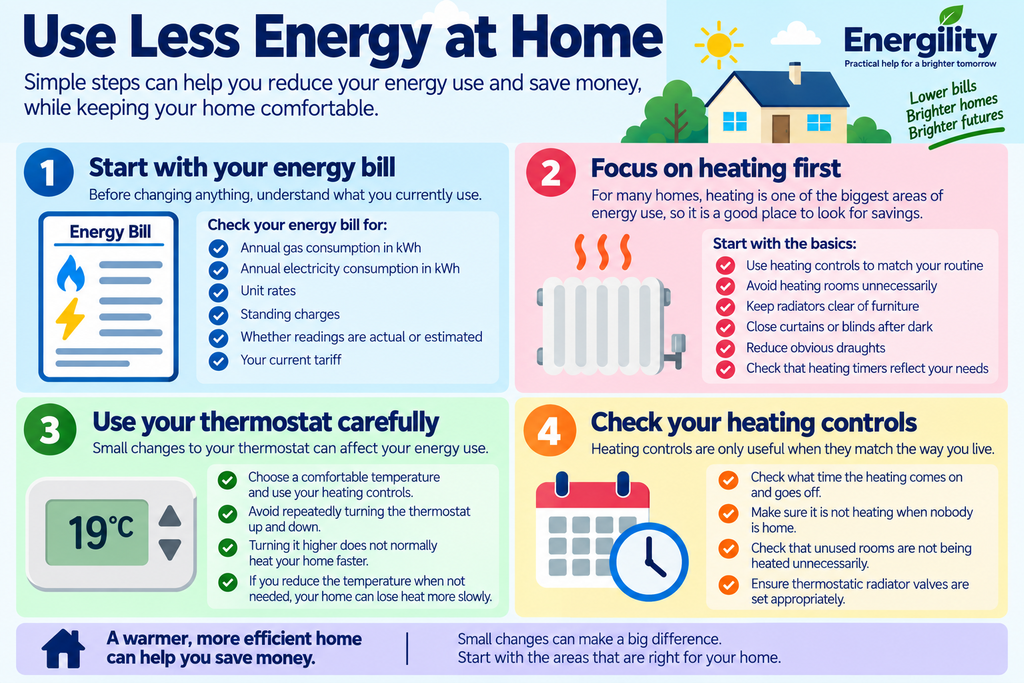
Before changing anything, understand what you currently use.
Start With Your Energy Bill
Check your energy bill for:
- Annual gas consumption in kWh
- Annual electricity consumption in kWh
- Unit rates
- Standing charges
- Whether readings are actual or estimated
- Your current tariff
Compare your energy consumption, rather than just the amount you pay.
A higher bill does not necessarily mean you used more energy. Prices, standing charges and account adjustments can also change.
Learn how to understand your energy bill →
Focus on Heating First
For many homes, space heating is one of the biggest areas of energy consumption.
That makes heating a sensible place to look for savings.
Start with the basics:
- Use heating controls to match your routine
- Avoid heating rooms unnecessarily
- Use thermostatic radiator valves appropriately where fitted
- Keep radiators clear of furniture where possible
- Close curtains or blinds after dark
- Reduce obvious draughts
- Check that heating timers reflect when you actually need heat
The objective is not to tolerate an uncomfortably cold home.
It is to avoid heating spaces unnecessarily or to a higher temperature than you need.
Use Your Thermostat Carefully
Small changes to the thermostat can affect energy consumption.
Rather than repeatedly turning the thermostat up and down, choose a comfortable temperature and use your heating controls to determine when the system operates.
Turning a room thermostat higher does not normally make the property heat up faster. It simply asks the heating system to continue until a higher temperature is reached.
If you reduce the temperature when heating is not needed, your home generally loses heat more slowly because the difference between indoor and outdoor temperature is smaller.
However, take particular care if someone in the household is older, very young or has a health condition that makes them vulnerable to cold.
Check Your Heating Controls
Heating controls are only useful when they match the way you live.
Check:
- What time the heating comes on
- What time it goes off
- Whether it operates when nobody is home
- Whether unused rooms are being heated unnecessarily
- Whether thermostatic radiator valves are set appropriately
Modern controls may allow different heating schedules for different days or areas of the property.
Spend a little time learning how yours work.
A well-controlled heating system can reduce unnecessary energy use without reducing comfort.
Keep the Heat You Have Paid For
Once you have heated your home, try to slow down how quickly that heat escapes.
Simple measures can include:
- Closing curtains or blinds at night
- Reducing draughts around doors and windows
- Using draught-proofing where appropriate
- Keeping internal doors closed where this helps maintain different room temperatures
- Making sure loft hatches and external doors close properly
Larger improvements such as loft, wall or floor insulation can make a much greater difference, depending on the property.
Use Hot Water More Efficiently
Heating water also requires energy.
You can reduce unnecessary hot-water use by:
- Taking shorter showers
- Fixing dripping hot taps
- Turning taps off when hot water is not needed
- Using an appropriate shower flow rate
- Insulating accessible hot-water pipes where suitable
- Insulating a hot-water cylinder where additional insulation is appropriate
- Setting hot-water schedules to match your needs
If you have a hot-water cylinder or immersion heater, understand when and how it is being heated.
Heating water when nobody needs it can waste energy.
Be Careful With Boiler Settings
If you have a gas boiler, its controls and settings can affect efficiency.
For a combi boiler, reducing the central-heating flow temperature may improve efficiency in suitable systems while still keeping the home comfortable.
This is different from changing the temperature of stored domestic hot water, where appropriate temperatures are important for hygiene and safety.
Don’t change settings you do not understand. The appropriate setup depends on your heating system and property.
Check Boiler Pressure — But Don’t Chase a Particular Number
If you have a sealed heating system, the boiler pressure gauge should remain within the range specified by the manufacturer.
Many systems operate somewhere around 1 to 1.5 bar when cold, but this is not a universal target for every boiler.
Check your boiler manual for the correct pressure range.
If the pressure repeatedly falls or rises outside the normal range, there may be a problem that needs investigation.
Reduce Electricity Used on Standby
Many modern devices use very little electricity on standby individually, but unnecessary consumption can still add up across a household.
Where practical, switch off devices that do not need to remain powered.
However, don’t automatically switch everything off at the wall.
Some equipment needs continuous power for settings, updates, recordings, security, connectivity or safe operation.
Focus on devices that can genuinely be switched off without causing problems.
Use Washing Machines and Dishwashers Efficiently
Appliances that heat water can use significant amounts of electricity.
Where appropriate:
- Wash full loads rather than several small ones
- Use eco programmes
- Wash clothes at lower temperatures when suitable
- Avoid unnecessary pre-washing
- Use dishwasher eco programmes
- Let clothes air-dry when practical
Eco programmes can take longer, but they are generally designed to reduce energy and water consumption.
Think Carefully About Tumble Drying
Tumble dryers can be relatively energy-intensive appliances.
When practical, drying clothes naturally can reduce electricity consumption.
If you use a tumble dryer:
- Spin clothes thoroughly first
- Clean filters as instructed
- Avoid running very small loads unnecessarily
- Use sensor drying where available
- Don’t continue drying clothes once they are already dry
If you are replacing a dryer, energy consumption is worth considering alongside purchase price.
Use Lighting Efficiently
Lighting is an easy area to manage.
Turn lights off when they are not needed and make good use of natural daylight.
If you still use older inefficient bulbs, replacing frequently used lights with suitable LEDs can substantially reduce the electricity required for lighting.
There is little benefit, however, in replacing working efficient LED bulbs simply for the sake of buying newer ones.
Cook With Less Energy
Small changes in the kitchen can reduce unnecessary energy use.
For example:
- Boil only the amount of water you need
- Put lids on pans where appropriate
- Match the pan to the hob ring
- Avoid unnecessarily preheating an oven
- Avoid repeatedly opening the oven door
- Use smaller appliances where they are genuinely more efficient for the task
The most efficient appliance depends on what you are cooking and how much of it.
An air fryer, microwave or slow cooker is not automatically cheaper for every meal.
Understand Which Appliances Cost the Most
The power rating of an appliance tells you how quickly it uses energy while operating.
But power alone does not tell you what it costs over a year.
You also need to know how long and how often you use it.
A high-powered appliance used for five minutes may consume less energy overall than a lower-powered appliance running for many hours.
A useful calculation is:
Power in kW × time in hours = energy used in kWh
Then:
kWh used × unit rate = approximate energy cost
Learn how much your appliances cost to run →
Use Smart Meter Information as a Tool
If you have a smart meter and an in-home display, it can help you see how energy use changes as different appliances and heating systems operate.
Don’t become fixated on every small movement in the display.
Instead, use it to identify patterns.
For example:
- What happens when the heating comes on?
- How much electricity does the household use overnight?
- What changes when the tumble dryer is running?
- Is there unexpectedly high consumption when the house is empty?
The information is most useful when it helps you identify something you can actually change.
Learn more about smart meters →
Could a Time-of-Use Tariff Help?
Some electricity tariffs charge different prices at different times.
Examples include traditional multi-rate tariffs such as Economy 7 and newer smart time-of-use tariffs.
They can work well for households able to move significant electricity consumption into cheaper periods.
This might include:
- Charging an electric vehicle
- Running a dishwasher
- Using a washing machine
- Charging a home battery
- Heating water where appropriate
However, cheaper off-peak electricity may be accompanied by higher prices at other times.
So don’t assume a time-of-use tariff will automatically save money.
Your pattern of electricity use matters.
Use Timers Safely
Timers and delayed-start functions can help move some electricity use into cheaper periods.
However, don’t run appliances unattended simply to obtain a cheaper electricity rate if the manufacturer or fire-safety guidance advises against it.
Cost savings should never take priority over safe appliance use.
Review Your Tariff
Reducing consumption is only one side of the energy bill.
The other is what you pay for the energy you use.
Check:
- Gas unit rate
- Electricity unit rate
- Standing charges
- Fixed or variable pricing
- Tariff end date
- Exit fees
- Payment method
A household can be very energy-efficient and still pay more than necessary if its tariff is unsuitable.
Likewise, finding a cheaper tariff does not remove the benefit of reducing unnecessary consumption.
The two approaches work together.
Learn about choosing the right tariff →
Don’t Judge a Tariff by the Monthly Direct Debit
A lower Direct Debit does not necessarily mean cheaper energy.
Your Direct Debit is simply the way money is collected towards your account.
When comparing tariffs, look at the unit rates, standing charges and estimated annual cost based on your actual consumption.
Learn how to compare energy deals →
Energy-Saving Myths
“Turning the thermostat higher heats the home faster”
Generally, no.
The thermostat determines the temperature the heating system is trying to reach. Setting a much higher temperature does not normally make a conventional heating system warm the property faster.
“It is cheaper to leave the heating on all day”
Generally, no.
A warmer home loses heat to the outside. Maintaining a higher indoor temperature for longer normally means more heat must be supplied to replace what is lost.
Heating controls should instead be used to provide appropriate warmth when it is needed.
“Everything on standby wastes lots of electricity”
Not necessarily.
Some modern electronics have very low standby consumption.
Standby use can still add up, but it is better to identify meaningful sources of consumption than to worry about every tiny load.
“An old appliance should always be replaced”
No.
A newer appliance may use less energy, but manufacturing and buying a replacement also have costs.
Consider how much energy the existing appliance actually uses, how often it is used and whether it needs replacing anyway.
“Energy saving means being uncomfortable”
It shouldn’t.
The best energy-saving measures reduce waste while maintaining an appropriate level of comfort.
Bigger Improvements Can Produce Bigger Savings
Everyday habits are useful, but there is a limit to how much behavioural changes alone can achieve.
Depending on your property, larger improvements might include:
- Loft insulation
- Wall insulation
- Floor insulation
- Draught-proofing
- Improved heating controls
- Heating-system improvements
- Better windows or doors where appropriate
- Solar PV
- Heat pumps
- Battery storage
Not every measure will be suitable or cost-effective for every property.
This is why understanding the building should come before buying technology.
If You Are Struggling to Afford Energy
Energy efficiency cannot solve every affordability problem.
If you are struggling to heat your home or keep up with energy payments, don’t assume the answer is simply to use less.
Depending on your circumstances, financial support, supplier assistance or other help may be available.
A Better Order for Cutting Your Energy Costs
If you are unsure where to begin, I would follow this order:
1. Understand your bill.
Know how much energy you use and what you pay for it.
2. Stop obvious waste.
Look at heating schedules, hot water, appliances and unnecessary consumption.
3. Improve control.
Use thermostats, timers and other controls properly.
4. Improve the property.
Consider insulation and other appropriate efficiency measures.
5. Review your tariff.
Make sure the price and structure suit your consumption.
6. Consider larger technologies.
Only then assess options such as solar PV, batteries or heat pumps where appropriate.
In Short
Reducing your energy bills is not about making your life uncomfortable.
Start by understanding how much energy you use and what you pay for it.
Then reduce unnecessary heating, hot-water and electricity use.
Use your controls properly.
Improve the building where it makes sense.
And make sure your tariff suits the way you actually use energy.
Small changes can help, but don’t obsess over tiny savings while ignoring the big picture.
Understand your energy. Reduce the waste. Then spend your money where it makes the greatest difference.
Important Information
Energility provides general information to help you understand energy, household and business costs, services and ways to save money. It is not financial, legal, tax, technical or professional advice.
Prices, tariffs, grants, government schemes, regulations and other information can change. Costs, savings and calculator results are estimates and your actual results may be different.
Before making an important financial decision, signing a contract or carrying out significant work, check the latest information and consider getting advice from a suitably qualified professional where needed.
Energility may receive a commission or other benefit from some links or services. Where this applies, we aim to make it clear. This does not increase the price you pay unless stated otherwise.
Energility
Learn. Compare. Save.