
A Simple Guide to Comparing Deals and Moving Supplier
Switching energy supplier can seem confusing at first. However, once you understand the steps, the process is usually straightforward.
You do not need to change your meter, and your gas or electricity supply will not be interrupted. In most cases, your new supplier handles the switch for you.
Why Switch Energy Supplier?
Energy prices change over time, so your current tariff may no longer be the best option.
Switching may help you:
- Lower your bills
- Find a better tariff
- Choose greener energy
- Get better customer service
- Avoid costly default tariffs
However, switching is not always right for everyone. So, it is important to compare carefully before making a decision.
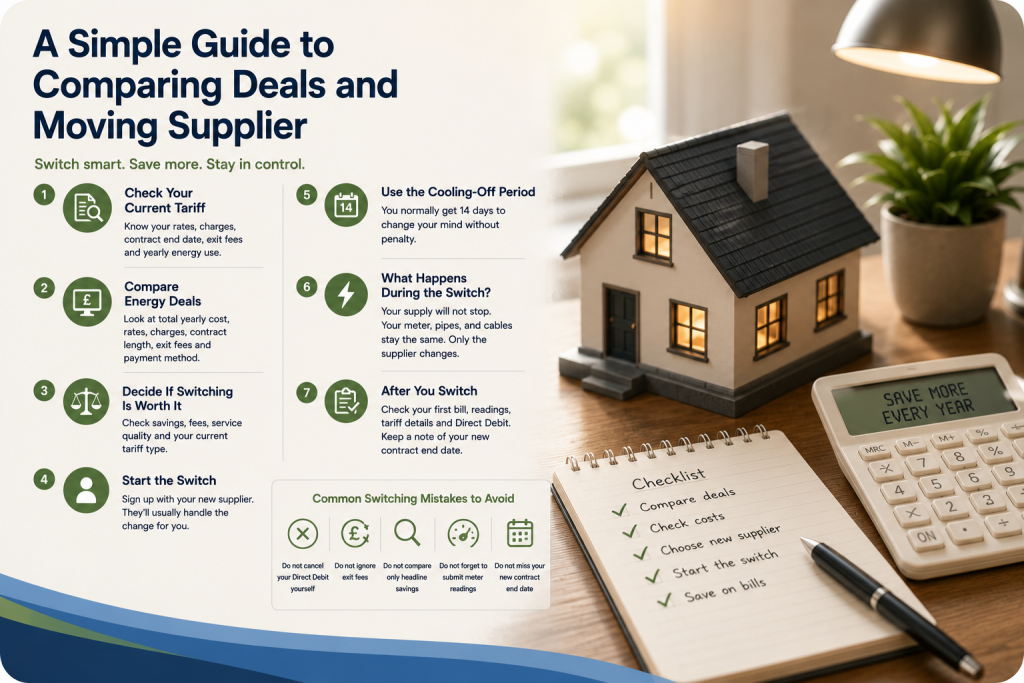
1. Check Your Current Tariff
Before you switch, look at your current deal.
Check:
- Your unit rate
- Your standing charge
- Your contract end date
- Any exit fees
- Your yearly energy use
This helps you compare new deals fairly.
2. Compare Energy Deals
Next, use a trusted comparison website to look at available tariffs.
When comparing deals, do not focus only on headline savings. Instead, check the full cost.
Look at:
- Total yearly cost
- Unit rates
- Standing charges
- Contract length
- Exit fees
- Payment method
This gives you a clearer picture of what you may actually pay.
3. Decide If Switching Is Worth It
Switching may be worth it if:
- Your fixed deal has ended
- You are on a costly standard tariff
- A cheaper deal is available
- You want greener energy
- Your supplier gives poor service
However, switching may not help if exit fees are high or the savings are very small.
So, compare both the cost and the service before you decide.
4. Start the Switch
Once you choose a new tariff, sign up with the new supplier.
You will usually need:
- Your postcode
- Your current supplier
- A recent energy bill
- Meter readings
- Bank details if paying by Direct Debit
After that, your new supplier will normally contact your old supplier and manage the change.
5. Use the Cooling-Off Period
After signing up, you normally get a 14-day cooling-off period.
This means you can change your mind without penalty during that time.
So, if you spot a problem or find a better deal, you still have time to cancel.
6. What Happens During the Switch?
Your energy supply will not stop.
Your gas, electricity, pipes, cables, and meter all stay the same. The main change is who sends your bill.
Your new supplier will confirm when the switch is complete.
7. After You Switch
Once the switch is complete, check your first bill carefully.
Make sure:
- The opening meter reading is correct
- Your tariff details match what you chose
- Your Direct Debit amount looks reasonable
- Your old supplier sends a final bill
It is also worth keeping a note of your new contract end date, so you can review your tariff again later.
Common Switching Mistakes to Avoid
Try to avoid these simple mistakes:
- Do not cancel your Direct Debit yourself
- Do not ignore exit fees
- Do not compare only headline savings
- Do not forget to submit meter readings
- Do not miss your new contract end date
Small checks can prevent bigger problems later.
In Short
Switching energy supplier is usually simple when you follow the right steps.
First, check your current tariff. Then, compare deals carefully. After that, choose a new supplier and let them handle the switch.
Your supply will not be interrupted, and your meter will stay the same.
With a little care, switching can help you find a better deal and stay more in control of your energy costs.
Important Information
Energility provides general information to help you understand energy, household and business costs, services and ways to save money. It is not financial, legal, tax, technical or professional advice.
Prices, tariffs, grants, government schemes, regulations and other information can change. Costs, savings and calculator results are estimates and your actual results may be different.
Before making an important financial decision, signing a contract or carrying out significant work, check the latest information and consider getting advice from a suitably qualified professional where needed.
Energility may receive a commission or other benefit from some links or services. Where this applies, we aim to make it clear. This does not increase the price you pay unless stated otherwise.
Energility
Learn. Compare. Save.