
Household appliances use different amounts of electricity.
Some use a lot of power for a short time. Others use less power but run for many hours.
So, an appliance with a high power rating is not necessarily the most expensive to use.
The amount of electricity it consumes depends on how much power it uses and how long it operates.
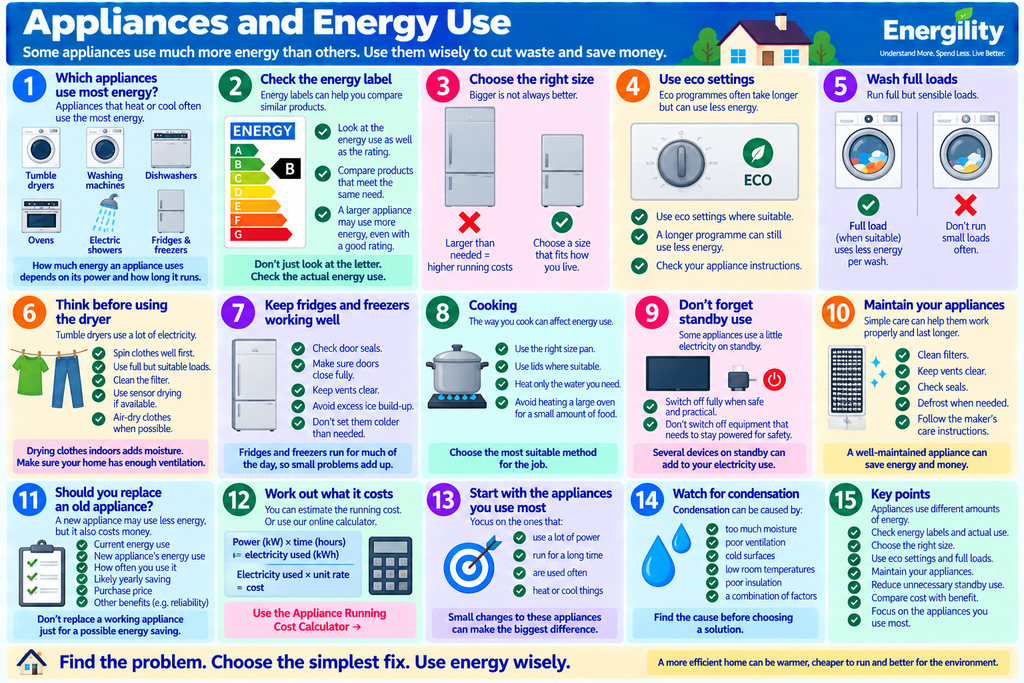
You can also reduce electricity consumption by choosing suitable settings, looking after your appliances and avoiding unnecessary use.
However, buying a new, more efficient appliance is not always the best way to save money.
First, understand what your existing appliances use and how you use them.
Which Appliances Use the Most Electricity?
There is no single answer for every household.
Electricity consumption depends on:
- the appliance’s power
- how long it operates
- how often you use it
- its efficiency
- the settings and programmes you choose
Appliances that heat or cool things can use substantial amounts of electricity.
These include:
- tumble dryers
- washing machines
- dishwashers
- ovens and electric hobs
- electric showers
- electric heaters
- fridges and freezers
However, how you use an appliance is just as important as its type.
For example, a powerful kettle normally operates for only a few minutes.
Meanwhile, a lower-powered appliance may run for several hours.
So, don’t judge electricity use by power alone.
What Is the Difference Between Power and Energy?
First, it helps to understand two measurements.
Power tells you how quickly an appliance uses electricity.
It is measured in:
- watts (W)
- kilowatts (kW)
Energy tells you how much electricity is used over time.
It is measured in:
- kilowatt-hours (kWh)
Your electricity bill uses kilowatt-hours to measure the electricity you consume.
Watts and Kilowatts
There are 1,000 watts in one kilowatt.
For example:
1,000 W = 1 kW
2,000 W = 2 kW
500 W = 0.5 kW
To convert watts into kilowatts, divide by 1,000.
How Do You Calculate Appliance Electricity Use?
For an appliance using a constant amount of power, the basic calculation is:
Power in kW × Time in hours = Electricity used in kWh
For example, imagine a 2 kW electric heater running continuously at full power for one hour.
The calculation would be:
2 kW × 1 hour = 2 kWh
If it ran continuously at full power for three hours:
2 kW × 3 hours = 6 kWh
So, both power and time matter.
However, many appliances do not operate at their full rated power continuously.
For example:
- a heater may switch its heating element on and off
- a fridge may cycle its compressor
- a washing machine may use different amounts of power during different parts of its programme
So, simple calculations based on rated power may only provide an estimate.
Where available, actual energy-consumption figures can be more useful.
How Do You Calculate the Running Cost?
Once you know how much electricity an appliance uses, multiply it by your electricity unit rate.
The calculation is:
Electricity used in kWh × Unit rate = Cost
For example, suppose your electricity unit rate is 25p per kWh.
If an appliance uses 2 kWh:
2 kWh × 25p = 50p
So, the estimated electricity cost would be 50p.
The 25p unit rate is only an example.
Use the unit rate from your own electricity tariff when calculating your costs.
If your tariff has different rates at different times, use the rate that applies when the electricity is consumed.
What If an Appliance Runs for Only a Few Minutes?
Many appliances operate for less than an hour.
So, you need to convert minutes into hours.
Use:
Minutes ÷ 60 = Hours
For example:
- 30 minutes = 0.5 hours
- 15 minutes = 0.25 hours
- 6 minutes = 0.1 hours
- 3 minutes = 0.05 hours
You can then use the normal electricity-consumption calculation.
Example: How Much Does It Cost to Boil a Kettle?
Imagine a kettle rated at 3 kW.
Suppose it operates at that power for three minutes.
First, convert the time into hours:
3 ÷ 60 = 0.05 hours
Then calculate the electricity used:
3 kW × 0.05 hours = 0.15 kWh
At an example electricity rate of 25p per kWh:
0.15 kWh × 25p = 3.75p
So, that boil would cost approximately 4p.
This is only an illustrative example.
The actual electricity used depends on the kettle, the amount of water and the time it takes to boil.
It also shows why a high-power appliance does not necessarily cost a lot each time you use it.
Example: How Much Does an Electric Heater Cost?
Now consider a 2 kW electric heater.
If it operates continuously at full power for three hours:
2 kW × 3 hours = 6 kWh
At an example unit rate of 25p per kWh:
6 kWh × 25p = £1.50
So, the estimated cost would be £1.50.
However, a heater controlled by a thermostat may not draw its full rated power throughout that period.
Its actual electricity use may therefore be lower.
Learn more: Electric Heating →
How Can You Find an Appliance’s Electricity Use?
You can often find information on:
- the appliance label
- its rating plate
- the instruction manual
- the manufacturer’s website
- its energy label, where applicable
The power rating may be shown in watts or kilowatts.
However, a power rating does not always tell you how much electricity the appliance actually uses.
For example, a washing machine may draw a relatively high amount of power when heating water but much less during other parts of the cycle.
So, where possible, look for an energy-consumption figure for a complete cycle or a defined period.
You may also be able to measure the electricity used by some suitable plug-in appliances using an appropriately rated electricity monitor.
Always follow the equipment’s safety instructions.
Use the Appliance Running Cost Calculator
You do not need to calculate everything yourself.
Energility’s Appliance Running Cost Calculator can help you estimate electricity consumption and running costs.
Enter:
- the appliance power
- how long you use it
- your electricity unit rate
The calculator will estimate the electricity used and its cost.
Remember that the result assumes the power entered represents the appliance’s consumption during the selected period.
If the appliance changes its power while operating, the result may only be an estimate.
Use the Appliance Running Cost Calculator →
Do You Need to Include the Standing Charge?
Normally, no.
When calculating the extra electricity cost of using one appliance, you generally only need the electricity unit rate.
The standing charge is normally payable each day regardless of whether that particular appliance is switched on.
So, for a simple appliance running-cost calculation:
Electricity used × Unit rate = Additional electricity cost
Learn more: Energy Charges Explained →
How Can You Reduce Appliance Electricity Use?
Once you understand how appliances use electricity, you can look for ways to reduce unnecessary consumption.
The aim is not simply to use appliances less.
It is to use them effectively while still meeting your household’s needs.
Check Energy Labels When Buying Appliances
Many new household appliances have energy labels.
These can help you compare the efficiency of different models.
However, don’t look only at the rating letter.
Also check the energy-consumption figure.
For example, two appliances may have the same efficiency rating but use different amounts of electricity.
This can happen because they have different capacities, sizes or features.
The measurement used on an energy label also depends on the type of appliance.
So, check whether the consumption is stated per cycle, over a specified number of cycles or over a year.
Compare appliances that meet the same need.
Learn more: Energy Labels Explained →
Choose the Right Appliance Size
Bigger is not always better.
A larger fridge, freezer, washing machine or dishwasher may use more electricity than a smaller model.
So, consider the capacity your household actually needs.
For example, a large dishwasher may be useful for a family.
However, a smaller household might not need that capacity.
Likewise, a large fridge-freezer may offer little benefit if much of its storage space is rarely used.
Choose appliances that suit how you live rather than automatically choosing the largest available model.
Use Eco Programmes Where Suitable
Many washing machines and dishwashers have eco programmes.
These programmes often take longer than standard programmes.
However, they can use less electricity.
This is because heating water can account for a significant part of the energy used during a wash.
An eco programme may use less water, a lower temperature or a different washing process.
So, a longer programme does not automatically mean greater electricity consumption.
Check the manufacturer’s instructions to understand how the eco setting works.
And choose a programme suitable for the load and cleaning required.
Wash Sensible Full Loads
Where suitable, try to run washing machines and dishwashers with sensible full loads.
This can reduce the number of cycles needed.
However, don’t overload the appliance.
Overloading may reduce cleaning performance and can put unnecessary strain on the equipment.
So, follow the manufacturer’s loading guidance.
Use Lower Washing Temperatures Where Suitable
Heating water requires energy.
So, washing clothes at a lower temperature can often reduce electricity consumption.
However, the correct temperature depends on what you are washing.
Some fabrics and items may need particular washing conditions.
And hygiene requirements may also affect the programme you choose.
So, use the lowest suitable temperature rather than assuming every load should be washed in the same way.
Think Before Using the Tumble Dryer
Tumble dryers use energy to remove moisture from clothes.
So, reducing unnecessary tumble-dryer use can help lower electricity consumption.
Where suitable, you could:
- use an effective spin cycle before drying
- dry sensible loads without overloading
- clean the lint filter as recommended
- use sensor drying if available
- avoid continuing to dry clothes that are already dry
- air-dry clothes when practical
Different types of tumble dryer can also use different amounts of electricity.
So, if you are buying a replacement, compare the published energy-consumption figures.
However, remember that drying clothes indoors releases moisture into your home.
Without suitable ventilation, this can contribute to condensation and damp problems.
So, consider ventilation and moisture control as well as electricity use.
Learn more: Draught-Proofing and Ventilation →
Keep Fridges and Freezers Working Properly
Fridges and freezers operate throughout the day and night.
So, small problems can increase electricity consumption over time.
Check that:
- door seals are in good condition
- doors close properly
- ventilation openings are clear
- frost does not build up excessively
- temperature settings are suitable
- the appliance is maintained according to its instructions
Avoid setting the appliance colder than necessary.
However, food must still be stored at safe temperatures.
Also, follow food-safety guidance when cooling and storing cooked food.
Good maintenance can help avoid unnecessary electricity use while keeping food stored safely.
Use Cooking Appliances Efficiently
The way you cook can affect how much energy you use.
For example:
- use a suitable pan size
- use lids where appropriate
- avoid heating more water than necessary
- follow the kettle’s minimum-fill instructions
- avoid unnecessary oven preheating where the cooking instructions allow
- consider a suitable smaller appliance for small amounts of food
However, one cooking method is not always cheaper than another.
The amount of food, cooking time, appliance efficiency and cooking method all matter.
For example, a smaller cooking appliance may use less electricity for a small meal.
But that does not mean it will always be the most economical option for every meal.
Compare the energy used to complete the task rather than the appliance’s power rating alone.
Don’t Forget Standby Electricity
Some electrical equipment continues to use a small amount of power when it appears to be switched off.
This is called standby power.
For one modern appliance, the amount may be small.
However, several devices left in standby mode for long periods can add to your electricity use.
So, switch off equipment fully where it is safe and practical.
However, don’t disconnect equipment that needs to remain powered for safety, security, essential communications or another important reason.
And keep standby consumption in perspective.
Reducing a small standby load may save much less electricity than improving the way you use a high-consumption appliance.
Maintain Your Appliances
Looking after appliances can help them operate properly.
Simple maintenance may include:
- cleaning filters
- keeping ventilation openings clear
- checking door seals
- defrosting when required
- following the manufacturer’s care instructions
Maintenance can also help equipment last longer.
And avoiding premature replacement may save money beyond the electricity costs alone.
Should You Replace an Old Appliance?
Not necessarily.
A new appliance may use less electricity than an older one.
However, buying it also costs money.
So, before replacing a working appliance solely to reduce electricity consumption, compare:
- how much electricity the existing appliance uses
- how much electricity the replacement is expected to use
- how often you use it
- the likely annual electricity saving
- the purchase and installation cost
- expected maintenance and repair costs
For example, imagine a replacement appliance costs £500.
Suppose it would save £20 a year on electricity.
The simple calculation would be:
£500 ÷ £20 = 25 years
So, based only on those electricity savings, it would take 25 years to recover the purchase price.
This is an illustrative simple-payback calculation, not a prediction.
It does not account for future electricity prices, repairs, equipment life or other costs and benefits.
Of course, there may be other reasons to replace an appliance.
For example, the existing appliance may be unreliable, damaged, too small or no longer suitable.
But don’t assume that buying a more efficient model will automatically save money overall.
Compare the full cost with the expected benefit.
Where Should You Start?
You don’t need to investigate every electrical device in your home.
Instead, start with appliances that:
- use substantial power
- run for long periods
- are used frequently
- heat or cool things
Then consider whether small changes could reduce unnecessary electricity consumption.
For example, you might:
- use a suitable eco programme
- reduce unnecessary washing or drying cycles
- improve fridge or freezer maintenance
- avoid heating more water than needed
- switch off unnecessary standby equipment
- check whether an appliance is using more electricity than expected
If you’re considering a replacement, calculate the likely running-cost difference before making a decision.
The aim is to identify changes that provide useful benefits without unnecessary spending.
Key Points
- Power and energy are different. Watts and kilowatts measure power. Kilowatt-hours measure energy consumed over time.
- Power alone does not tell you the running cost. How long an appliance operates matters too.
- To estimate electricity use: Power in kW × time in hours = energy in kWh.
- To estimate running cost: Electricity used in kWh × unit rate = cost.
- High power does not always mean high cost. A powerful kettle used briefly may consume less electricity than a lower-powered appliance operating for hours.
- Actual consumption can vary. Many appliances change their power during operation.
- Check energy labels when buying appliances. Compare energy consumption and capacity, not just the rating letter.
- Choose the right size. Avoid paying to buy and operate capacity you do not need.
- Use eco settings where suitable. A longer programme can sometimes use less electricity.
- Wash sensible loads and use suitable temperatures. Avoid unnecessary cycles without compromising cleaning or hygiene.
- Think about tumble-dryer use. Air-drying may reduce electricity consumption, but indoor moisture and ventilation also matter.
- Maintain fridges and freezers. Check seals, ventilation, frost and temperature settings.
- Cook efficiently. Avoid heating more water, food or equipment than necessary.
- Reduce unnecessary standby electricity where safe and practical.
- Maintain appliances properly. This may help reduce waste and extend their useful life.
- Don’t automatically replace working appliances. Compare the purchase price with realistic electricity savings.
- Use the Appliance Running Cost Calculator to estimate how much electricity an appliance uses and what it costs.
Most importantly, focus on the appliances that use meaningful amounts of electricity and the changes that make a worthwhile difference.
Important Information
Energility provides general educational information to help people understand energy use, household costs and ways to improve energy efficiency.
The information is not financial, legal, technical or other professional advice.
Electricity prices, tariffs, appliance specifications and other information can change.
All example costs and savings are illustrative. Your actual results may differ depending on your appliances, electricity tariff and usage.
Before buying expensive equipment or carrying out significant electrical work, check current information and consider advice from a suitably qualified professional where appropriate.
Next: Energy Labels Explained
Understanding energy labels can help you compare appliances when you need to buy or replace equipment.
Next: Energy Labels Explained →
Energility
Learn More. Spend Less.