
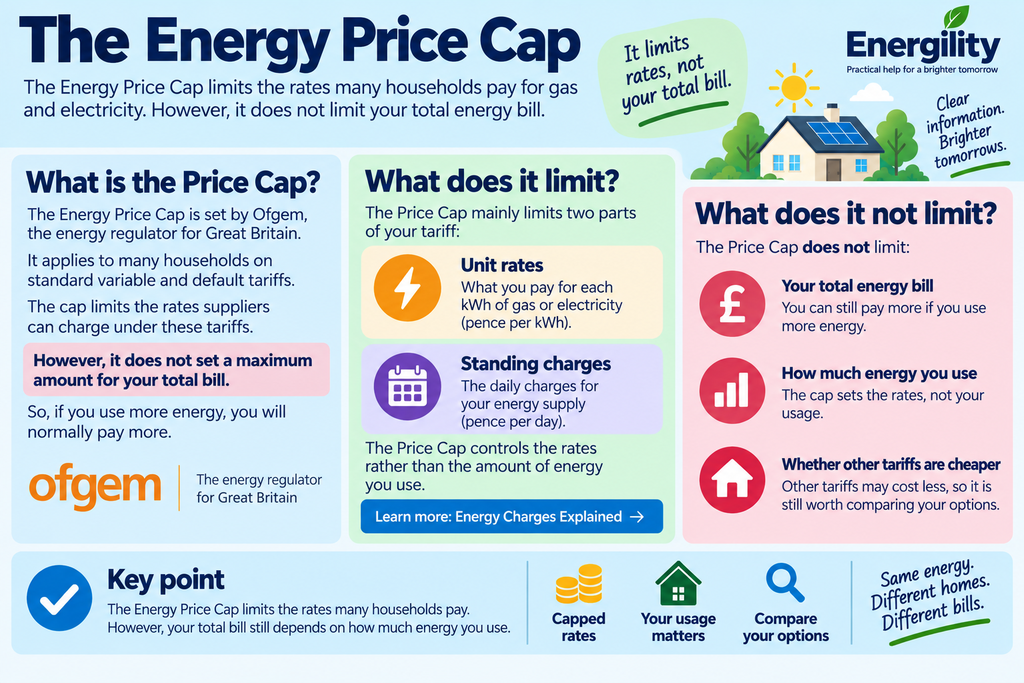
The Energy Price Cap limits the rates many households pay for gas and electricity. However, it does not limit your total energy bill.
What Is the Price Cap?
The Energy Price Cap is set by Ofgem, the energy regulator for Great Britain.
It applies to many households on standard variable and default tariffs.
The cap limits the rates suppliers can charge under these tariffs.
However, it does not set a maximum amount for your total bill.
So, if you use more energy, you will normally pay more.
What Does It Limit?
The Price Cap mainly limits two parts of your tariff:
- Unit rates — what you pay for each kWh of gas or electricity.
- Standing charges — the daily charges for your energy supply.
Therefore, the Price Cap controls the rates rather than the amount of energy you use.
Learn more: Energy Charges Explained →
Why Is There a Yearly Figure?
You will often see the Price Cap shown as a yearly amount.
However, this figure is not the most you can pay.
Instead, it shows what a typical household would pay at the capped rates based on set levels of energy use.
So, your own bill could be higher or lower.
If you use more energy than the example household, you may pay more. Likewise, if you use less, you may pay less.
A Simple Example
Imagine the electricity unit rate is 25p per kWh.
If you use 2,000 kWh:
2,000 × 25p = £500
However, if you use 4,000 kWh:
4,000 × 25p = £1,000
The unit rate has not changed. Instead, the cost is higher because you used more electricity.
You would also need to add the standing charge.
So, the key point is simple:
The Price Cap limits rates, not bills.
Who Does It Cover?
The Price Cap covers many homes on standard variable and default tariffs in England, Scotland and Wales.
It can apply to different ways of paying, including:
- Direct Debit
- standard credit
- prepayment
However, the rates can differ depending on where you live and how you pay.
So, always check the rates that apply to your own tariff.
What About Fixed Tariffs?
A fixed tariff works differently.
When you choose a fixed tariff, your unit rates and standing charges are normally fixed for a set time.
Therefore, your rates do not usually change each time the Price Cap changes.
However, a fixed tariff is not always cheaper.
So, before you fix, compare the rates, tariff length and any exit fees.
When Does It Change?
Ofgem updates the Price Cap every three months.
The periods are:
- January to March
- April to June
- July to September
- October to December
Therefore, rates on affected tariffs can change four times a year.
Your supplier should tell you if your rates are going to change.
Why Does It Change?
The cost of supplying energy changes over time.
For example, suppliers have to pay for gas and electricity, energy networks and other costs.
As these costs change, the Price Cap can also rise or fall.
However, changes in wholesale energy prices do not always reach household bills straight away.
This is because suppliers often buy some energy in advance.
Are Rates the Same Everywhere?
No.
Your rates can vary depending on where you live, how you pay and the type of tariff you have.
Therefore, the rates you see in the news may not be exactly the same as your own rates.
So, check your bill or supplier account for the figures that apply to you.
Current Price Cap
The Price Cap changes every three months.
Therefore, current figures can quickly become out of date.
View the latest Energy Price Cap rates →
When checking the latest figures, remember that the headline yearly amount is only an example.
Your own costs depend on your rates and how much energy you use.
Does It Mean Cheapest?
No.
The Price Cap gives many households some protection from high rates. However, it does not mean a capped tariff is the cheapest choice available.
Other tariffs may cost less.
So, it can still be worth comparing your choices.
When you compare, use your own yearly energy use where possible. This gives you a much better idea of what each tariff may cost.
Key Points
The Energy Price Cap limits the rates on many household energy tariffs.
However, it does not limit your total bill.
So, remember:
- the cap mainly limits unit rates and standing charges
- your bill still depends on how much energy you use
- the headline yearly figure is only an example
- the cap changes every three months
- your own rates may differ from national averages
Most importantly, check your own rates and energy use rather than relying on the headline Price Cap figure.
Important Information
Energility provides general information to help you understand energy, household and business costs, services and ways to save money. It is not financial, legal, tax, technical or professional advice.
Prices, tariffs, grants, government schemes, regulations and other information can change. Costs, savings and calculator results are estimates and your actual results may be different.
Before making an important financial decision, signing a contract or carrying out significant work, check the latest information and consider getting advice from a suitably qualified professional where needed.
Energility may receive a commission or other benefit from some links or services. Where this applies, we aim to make it clear. This does not increase the price you pay unless stated otherwise.
Next: Find Your Energy Supplier →
Energility
Learn. Compare. Save.