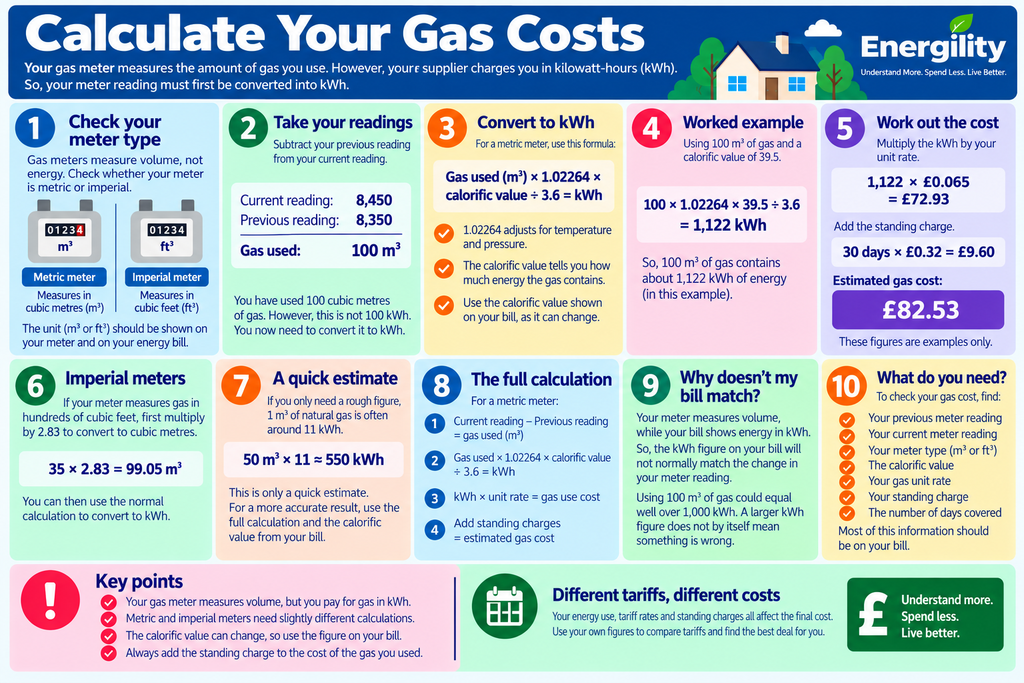
Unlike electricity, calculating the cost of the gas you use is not quite as simple as multiplying your meter reading by your unit rate.
Electricity meters generally measure consumption directly in kilowatt-hours (kWh). Gas meters, however, measure the volume of gas passing through the meter.
That volume must therefore be converted into kilowatt-hours before your supplier can calculate the cost.
Understanding this calculation can help you check your gas bill, estimate the cost of your heating and understand how your meter readings relate to the amount you actually pay.
What Does a Gas Meter Measure?
Your gas meter records the volume of gas used, rather than the amount of energy contained within it.
Modern metric gas meters normally measure gas in:
Cubic metres (m³)
Older imperial meters may measure gas in:
Hundreds of cubic feet (ft³)
Your energy supplier converts this measured volume into kilowatt-hours (kWh) because gas tariffs are charged according to the amount of energy supplied.
This means there are several stages between the number displayed on your gas meter and the cost appearing on your bill.
Step 1: Take Your Gas Meter Readings
First, you need to establish how much gas has been used.
Take the current meter reading and subtract the previous reading:
Current reading − Previous reading = Gas volume used
For example:
Current meter reading: 8,450 m³
Previous meter reading: 8,350 m³
Gas used:
8,450 − 8,350 = 100 m³
You have therefore used 100 cubic metres of gas.
This is not yet 100 kWh. The gas volume still needs to be converted into energy.
Step 2: Check Whether Your Meter Is Metric or Imperial
This is important because the calculation differs depending on the type of meter.
A metric meter records gas in cubic metres (m³).
An imperial meter records gas in hundreds of cubic feet.
The meter itself should indicate which measurement it uses, and your energy bill should also show the units associated with your meter readings.
If you have a metric meter, the volume can proceed directly to the next stage of the conversion.
If you have an imperial meter, the volume first needs to be converted into cubic metres.
Converting an Imperial Gas Reading
For an imperial meter, the measured volume in hundreds of cubic feet is converted to cubic metres using a conversion factor of approximately 2.83.
For example, if the difference between two imperial meter readings is:
35 units
The approximate metric volume is:
35 × 2.83 = 99.05 m³
The remaining calculation can then be performed using the converted volume.
Step 3: Apply the Volume Correction Factor
Gas expands and contracts depending on temperature and pressure.
The volume recorded by the meter therefore needs to be adjusted so that gas consumption can be calculated on a consistent basis.
For a typical domestic calculation, you will commonly see a volume correction factor of 1.02264.
Using our metric example:
100 m³ × 1.02264 = 102.264
This corrected volume is then used in the next stage.
Step 4: Apply the Calorific Value
Not every cubic metre of natural gas contains exactly the same amount of energy.
The calorific value (CV) represents the amount of energy contained within a given quantity of gas.
You may see a calorific value somewhere around 39–40 MJ/m³, but the actual figure used for your bill can vary.
For an accurate check of your bill, use the calorific value shown on the bill rather than assuming a fixed value.
Suppose the calorific value is:
39.5 MJ/m³
Our calculation becomes:
100 × 1.02264 × 39.5
which gives:
4,039.43 megajoules
We still need to convert this into kilowatt-hours.
Step 5: Convert Megajoules to Kilowatt-Hours
Gas is billed in kilowatt-hours, so the energy figure must be converted from megajoules (MJ) into kilowatt-hours (kWh).
One kilowatt-hour is equivalent to 3.6 megajoules.
We therefore divide the result by 3.6:
4,039.43 ÷ 3.6 = 1,122.06 kWh
So, in this example:
100 m³ of gas ≈ 1,122 kWh
The precise result depends on the calorific value used.
The Complete Metric Gas Formula
For a metric gas meter, the calculation can be expressed as:
Gas used (m³) × Volume correction factor × Calorific value ÷ 3.6 = Gas used in kWh
Using our example:
100 × 1.02264 × 39.5 ÷ 3.6
= approximately 1,122 kWh
Once you have the kWh figure, calculating the actual energy charge becomes much easier.
Step 6: Apply Your Gas Unit Rate
Your gas tariff will have a unit rate, normally expressed in pence per kilowatt-hour.
Suppose your unit rate is:
6.5p/kWh
Our calculated consumption was approximately:
1,122.06 kWh
The cost of the gas consumed would therefore be:
1,122.06 × £0.065 = £72.93
So the gas-use portion of the bill would be approximately:
£72.93
But that is not necessarily the total gas charge.
Step 7: Add the Standing Charge
Most gas tariffs also have a daily standing charge.
Suppose the standing charge is:
32p per day
and the billing period covers:
30 days
The standing charge would be:
30 × £0.32 = £9.60
Adding this to the gas consumption:
£72.93 + £9.60 = £82.53
The approximate gas cost for the period would therefore be £82.53, before considering any other relevant bill adjustments.
Complete Worked Example
Here is the entire calculation in one place.
| Item | Example |
|---|---|
| Previous meter reading | 8,350 m³ |
| Current meter reading | 8,450 m³ |
| Volume used | 100 m³ |
| Volume correction factor | 1.02264 |
| Calorific value | 39.5 MJ/m³ |
| Conversion to kWh | ÷ 3.6 |
| Calculated consumption | 1,122.06 kWh |
| Unit rate | 6.5p/kWh |
| Consumption cost | £72.93 |
| Standing charge | 32p/day |
| Billing period | 30 days |
| Standing charge cost | £9.60 |
| Approximate total | £82.53 |
The rates and calorific value above are examples rather than current tariff figures.
Why Is Calorific Value Necessary?
Natural gas is not completely identical everywhere or at every moment.
Its composition can vary, which means that the amount of energy contained within a cubic metre of gas can also vary.
Because customers are ultimately paying for energy, rather than simply a volume of gas, the calorific value allows the measured volume to be converted into an energy quantity.
This is why two identical volumes of gas do not necessarily represent exactly the same number of kilowatt-hours.
Where Can I Find the Calorific Value?
Your gas bill will normally provide information explaining how your gas consumption has been converted into kWh, including the calorific value used in the calculation.
If you are checking a particular bill, use the figures printed on that bill wherever possible.
This provides a more accurate result than using a generic online conversion such as assuming that one cubic metre always equals a particular number of kWh.
Why Does My Gas Meter Reading Not Match the kWh on My Bill?
This is a common source of confusion.
If your metric gas meter increases by 100 units, you have generally used 100 cubic metres of gas, not 100 kWh.
After the volume correction and calorific value calculations, those 100 cubic metres could represent well over 1,000 kWh of energy.
So seeing a much larger kWh figure on your bill does not, by itself, mean that your supplier has multiplied your consumption incorrectly.
The meter and the bill are measuring different things:
Meter: volume of gas
Bill: energy contained within that gas
A Useful Approximation
If you only want a quick estimate rather than an exact bill calculation, one cubic metre of natural gas is often roughly equivalent to around 11 kWh.
For example:
50 m³ × approximately 11 = approximately 550 kWh
This can be useful for quickly estimating consumption, but it should not replace the full calculation when checking the accuracy of a bill.
Use the actual calorific value and other information shown on your bill for a more precise calculation.
What If I Have a Smart Meter?
A smart gas meter does not remove the underlying need to convert gas volume into energy.
Your supplier still needs to calculate the amount of energy represented by the gas consumed before applying your tariff.
The major difference is that a functioning smart meter can send readings automatically, reducing the need for you to submit readings manually.
Your bill should still show your consumption in kWh.
Estimated and Actual Meter Readings
When checking your gas costs, also look at whether your bill is based on an actual meter reading or an estimated reading.
If the supplier does not have an up-to-date reading, it may estimate your consumption.
An estimate that is significantly different from your actual meter reading can make the bill appear unusually high or low.
Regular meter readings can therefore help keep your account aligned with your actual consumption.
If you have a smart meter but notice estimated readings appearing regularly on your bills, it may be worth checking whether the supplier is receiving readings correctly.
Why Gas Consumption Is Often Much Higher in Winter
For homes with gas central heating, consumption can vary enormously throughout the year.
During summer, gas might mainly be required for hot water and perhaps cooking.
During winter, the boiler may operate for several hours each day to heat the property.
Consequently, comparing one month’s gas consumption with another without considering the season can be misleading.
A better way to understand your consumption is to compare similar periods, such as this January with last January, while also considering differences in weather and occupancy.
Estimating Your Annual Gas Cost
If you know your expected annual consumption in kWh, you do not need to repeat the meter conversion to estimate a tariff’s annual cost.
For example, suppose your expected annual gas consumption is 10,000 kWh, your unit rate is 6.5p/kWh, and your standing charge is 32p/day.
Annual consumption cost:
10,000 × £0.065 = £650
Annual standing charge:
365 × £0.32 = £116.80
Estimated annual gas cost:
£650 + £116.80 = £766.80
This is one reason your annual kWh consumption is useful when comparing tariffs.
Checking Your Own Gas Bill
If you want to check the calculation on a gas bill, gather the following information:
- Previous meter reading
- Current meter reading
- Whether the meter is metric or imperial
- Volume correction factor
- Calorific value
- Gas unit rate
- Standing charge
- Number of days in the billing period
You can then work through the calculation from the original meter readings to the final estimated cost.
The Key Calculation
For a metric gas meter, remember:
(Current reading − Previous reading) × Volume correction factor × Calorific value ÷ 3.6 = kWh
Then:
kWh × unit rate = cost of gas used
And finally:
Cost of gas used + standing charges = approximate gas charge
For an imperial meter, the meter units first need to be converted to cubic metres.
The Key Point
Your gas meter measures volume, while your energy supplier charges you for energy.
That is why calculating gas costs involves more steps than calculating electricity costs.
The process is essentially:
Meter readings → Gas volume → Corrected volume → Calorific value → kWh → Unit rate → Cost
Once you understand that sequence, the calculation on a gas bill becomes considerably easier to follow.
And importantly, you can use it to check whether the consumption shown on your bill makes sense rather than simply accepting the final figure.