
Understand the Different Ways You Can Pay for Energy
Energy tariffs determine how your supplier charges you for gas and electricity.
Some tariffs provide greater price certainty. Others allow prices to change. Some electricity tariffs charge different rates depending on when you use energy.
There is no single tariff type that is best for everyone.
The right choice depends on your energy consumption, household routine, appetite for price changes and how much flexibility you want.
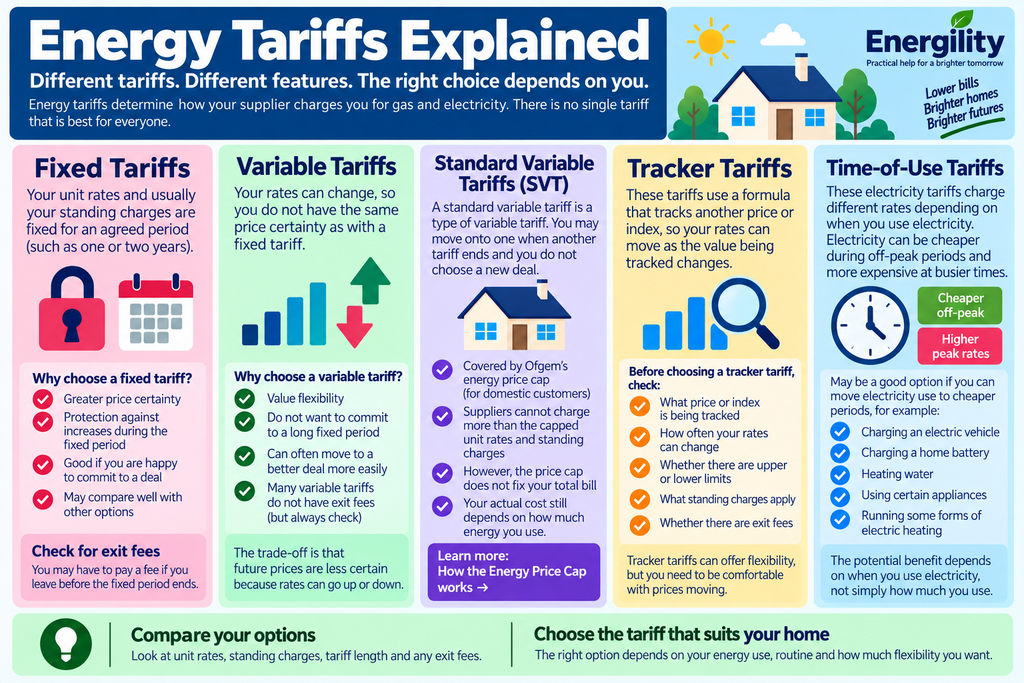
Fixed Energy Tariffs
With a fixed tariff, the unit rates and usually the standing charges are fixed for an agreed period.
This might be for one year, two years or another specified term.
However, a fixed tariff does not mean your total energy bill is fixed.
If you use more energy, you will still pay more. If you use less, you will generally pay less.
What is fixed is the price structure specified by the tariff, rather than the amount of energy you consume.
Why Choose a Fixed Tariff?
A fixed tariff can provide greater certainty about the rates you will pay during the fixed period.
This can be attractive if you:
- Prefer greater price certainty
- Want protection against increases in the tariff rates during the fixed term
- Are comfortable committing to a particular deal
- Find a fixed tariff that compares favourably with your alternatives
However, fixing also means you may not benefit automatically if other available energy prices fall.
Check the Exit Fees
Fixed tariffs can include exit fees.
These may apply if you leave the tariff before the end of the fixed period.
So don’t compare a fixed tariff using the unit rates alone.
Check:
- How long the tariff lasts
- The exit fee
- Whether the fee applies separately to gas and electricity
- What happens when the fixed period ends
If you think you may want to switch again soon, flexibility may be particularly important.
Variable Energy Tariffs
With a variable tariff, the rates you pay can change.
Your supplier must tell you about price changes in accordance with the applicable rules, but you do not have the same rate certainty as you would with a fixed tariff.
Variable tariffs can offer greater flexibility, and many do not have exit fees.
However, always check the terms of the particular tariff rather than assuming this is the case.
Why Choose a Variable Tariff?
A variable tariff may appeal if you:
- Value flexibility
- Do not want to commit to a long fixed period
- Want the ability to move relatively easily if better options become available
- Are comfortable with the possibility that rates could change
The trade-off is that future prices are less certain.
What Is a Standard Variable Tariff?
A standard variable tariff, sometimes called an SVT, is a type of variable tariff.
You may move onto a supplier’s standard or default tariff when another tariff ends and you do not choose a new deal.
For domestic customers covered by Ofgem’s energy price cap, the maximum unit rates and standing charges suppliers can charge are constrained by the cap.
However, the price cap does not fix your total bill.
Your actual cost still depends on how much energy you use.
Learn how the energy price cap works →
What Are Tracker Tariffs?
Some tariffs use a formula that tracks another price or index.
The rates can therefore move as the value being tracked changes.
The precise way this works depends on the tariff.
Do not assume that every tracker tariff follows the Ofgem price cap or wholesale energy prices in exactly the same way.
Before choosing one, understand:
- What price or index is being tracked
- How frequently your rates can change
- Whether there are upper or lower limits
- What standing charges apply
- Whether there are exit fees
Tracker tariffs can offer flexibility, but you need to be comfortable with prices moving.
What Are Time-of-Use Tariffs?
Some electricity tariffs charge different rates depending on when electricity is used.
These are often called time-of-use tariffs.
Electricity might be cheaper during certain off-peak periods and more expensive at busier times.
This can make them particularly interesting for households able to move substantial electricity consumption away from expensive periods.
For example:
- Charging an electric vehicle
- Charging a home battery
- Heating water
- Using certain appliances
- Running some forms of electric heating
The potential benefit depends on when you use electricity, not simply how much you use.
What About Economy 7?
Economy 7 is a long-established type of multi-rate electricity tariff.
It normally provides a cheaper electricity rate for a number of overnight hours and a different rate during the day.
It can be particularly relevant to homes using electric storage heaters or other equipment designed to make use of cheaper overnight electricity.
However, Economy 7 is not automatically cheaper.
If most of your electricity is consumed during the more expensive period, another tariff may offer better value.
What Are Smart Tariffs?
The term smart tariff covers tariffs that use smart-meter data to provide pricing or features that would be difficult or impossible with a traditional meter.
Some smart tariffs are time-of-use tariffs, but not every smart tariff works in exactly the same way.
Depending on the product, prices might:
- Vary between different periods of the day
- Change according to market conditions
- Offer particularly cheap periods for EV charging
- Reward electricity use at certain times
- Reward reductions in consumption during particular periods
These tariffs normally require a compatible smart meter that can provide the necessary consumption data.
Could a Smart or Time-of-Use Tariff Save You Money?
Possibly.
But the answer depends heavily on your household.
Suppose electricity is particularly cheap overnight but expensive during the early evening.
A household that can charge an EV and home battery overnight may benefit considerably.
Another household that uses most of its electricity during expensive peak periods might pay more.
Before choosing a time-of-use tariff, ask:
When do we actually use electricity?
That question matters more than whether the tariff is described as smart.
Think About Automation
Smart tariffs can become easier to use when appliances or technologies can operate automatically during cheaper periods.
Examples may include:
- EV smart charging
- Home batteries
- Hot-water controls
- Some heating systems
- Smart appliances
Instead of continually watching electricity prices yourself, compatible equipment may be able to schedule some consumption automatically.
However, check compatibility before choosing a tariff or buying equipment.
Fixed Versus Variable: Think About Risk
Choosing between fixed and variable pricing partly involves deciding which type of uncertainty you prefer.
With a fixed tariff, you know more about the rates you will pay during the fixed period, but market alternatives could subsequently become cheaper.
With a variable tariff, you retain greater exposure to future price changes, which could move in either direction.
Nobody can know with certainty what future energy prices will do.
So avoid choosing a tariff solely because you believe prices must rise or must fall.
Instead, consider how much price certainty matters to your household.
Don’t Compare the Direct Debit
This is one of the most important rules when choosing a tariff.
Do not decide that one tariff is cheaper simply because the proposed monthly Direct Debit is lower.
The Direct Debit is a payment arrangement, not the underlying price of the energy.
Compare the tariff itself using information such as:
- Unit rates
- Standing charges
- Your annual consumption
- Tariff structure
- Contract length
- Exit fees
Learn how to understand your energy bill →
Use Your Actual Consumption
Your previous energy bills can tell you approximately how much gas and electricity you use over a year.
Use those figures when comparing tariffs wherever possible.
For example, two households might be offered exactly the same tariffs but reach different conclusions because one uses much more energy than the other.
This is particularly important where tariffs have different combinations of unit rates and standing charges.
Don’t Look at the Unit Rate Alone
A low unit rate can be attractive.
But another tariff could have:
- A higher standing charge
- An exit fee
- More expensive peak periods
- Different contract conditions
This is why the cheapest-looking number is not necessarily the cheapest tariff overall.
Compare the estimated total cost based on the way you actually use energy.
Gas and Electricity Do Not Have to Be Together
You do not necessarily have to buy gas and electricity from the same supplier.
A dual-fuel tariff may be convenient, but convenience does not automatically mean it offers the best value.
Compare the available options rather than assuming both fuels should always remain together.
Think About More Than Price
Price is important, but it may not be your only consideration.
You may also care about:
- Customer service
- Billing quality
- App or online-account features
- Smart-meter compatibility
- Renewable or environmental features
- Payment options
- Support for vulnerable customers
- EV or battery integration
The relative importance of these will depend on your circumstances.
Which Tariff Type Might Suit You?
There is no universal answer, but this is a useful starting point.
Fixed tariff
Consider this if you value greater certainty over the rates you will pay and are comfortable with the terms of the fixed period.
Variable tariff
Consider this if flexibility matters and you are comfortable with rates potentially changing.
Tracker tariff
Consider this only if you understand what the tariff tracks and are comfortable with the resulting price movements.
Time-of-use or smart tariff
Consider this if you can move meaningful electricity consumption into cheaper periods and understand the more complex pricing structure.
Economy 7
Consider this particularly if your home has significant overnight electricity use, such as appropriately controlled storage heating.
These are starting points, not recommendations.
The actual tariff terms and your energy-use pattern matter more than the label.
Before Choosing a Tariff
Ask yourself:
- How much gas do I use each year?
- How much electricity do I use?
- When do I use electricity?
- Do I want price certainty or flexibility?
- How long am I comfortable committing?
- Are there exit fees?
- Could I move electricity use to cheaper periods?
- Do I have an EV, battery or electric heating?
- Does customer service matter strongly to me?
- What would the tariff cost based on my actual usage?
Then compare the available options.
Understand First. Then Compare.
Tariff names can make energy products sound more complicated than they really are.
Start by understanding the basic trade-offs:
Fixed → greater rate certainty.
Variable → rates can change.
Tracker → rates move according to a defined mechanism.
Time-of-use → the price depends partly on when you use electricity.
Then look beyond the label.
Check the unit rates, standing charges, contract terms, exit fees and estimated overall cost for your household.
Learn how to compare energy deals →
In Short
There is no single best energy tariff.
A fixed tariff may suit someone who values price certainty.
A variable tariff may suit someone who values flexibility.
A time-of-use tariff may suit a household able to shift substantial electricity consumption into cheaper periods.
But the tariff type is only the beginning.
The right comparison comes from understanding how much energy you use, when you use it, what the tariff charges and what conditions come with it.
Choose based on your household — not simply the tariff name.
Important Information
Energility provides general information to help you understand energy, household and business costs, services and ways to save money. It is not financial, legal, tax, technical or professional advice.
Prices, tariffs, grants, government schemes, regulations and other information can change. Costs, savings and calculator results are estimates and your actual results may be different.
Before making an important financial decision, signing a contract or carrying out significant work, check the latest information and consider getting advice from a suitably qualified professional where needed.
Energility may receive a commission or other benefit from some links or services. Where this applies, we aim to make it clear. This does not increase the price you pay unless stated otherwise.
Energility
Learn. Compare. Save.