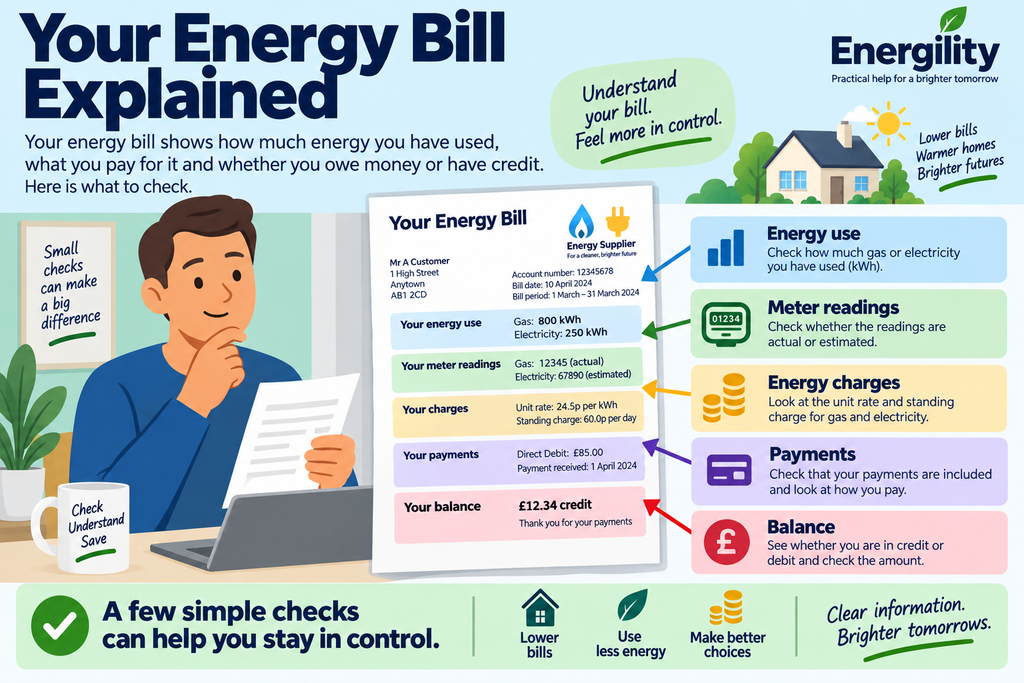
Understanding Your UK Energy Bill

Understand What You Are Paying For

Energy bills contain a lot of information.

You may see meter readings, kilowatt-hours, unit rates, standing charges, account balances and payment information all on the same document.

Once you know what these figures mean, your bill becomes much easier to understand.

More importantly, you can start checking whether you are being charged correctly and whether your tariff still suits you.

Start With the Billing Period

First, check the dates covered by the bill.

This tells you the period during which the energy was used.

When comparing one bill with another, remember that energy use can vary considerably throughout the year. A winter gas bill, for example, may naturally be much higher than a summer one because of heating.

So don’t judge your energy use from the amount due alone.

Look at how much energy you actually used.

Understanding Energy Usage

Gas and electricity consumption is charged in kilowatt-hours (kWh).

Your bill should show how many kWh you used during the billing period.

Ofgem describes the unit rate as the price you pay for each unit of gas or electricity used, measured in kWh.

For example, if you use:

100 kWh

at a unit rate of:

25p per kWh

the energy-use element would be:

100 × £0.25 = £25

before considering standing charges and any other applicable costs.

Understanding your kWh consumption is particularly useful because it allows you to compare your energy use, rather than simply comparing how much money left your bank account.

Understanding Your Unit Rate

Your unit rate is the amount you pay for each kWh of energy you use.

It is normally shown in pence per kWh (p/kWh).

Gas and electricity have separate unit rates.

If you have a multi-rate electricity tariff, such as Economy 7, you may have different rates depending on when the electricity is used. Ofgem confirms that multi-rate tariffs can have separate peak and off-peak unit rates.

When checking your bill, make sure the unit rate shown matches the tariff you agreed with your supplier.

Understanding Standing Charges

A standing charge is a daily charge set by your supplier.

You normally pay it for each day you remain connected under the tariff, regardless of how much energy you use. Ofgem includes standing charges alongside unit rates within the energy price cap for tariffs covered by it.

Gas and electricity normally have separate standing charges.

For example, a standing charge of:

60p per day

over 365 days would cost:

£219 per year

before considering the energy you actually use.

This is why standing charges can be particularly important for low-energy users.

Unit Rate + Standing Charge

These two figures are fundamental to understanding the basic cost of a tariff.

Very simply:

Energy used × unit rate

plus

Number of days × standing charge

gives you the main energy and standing-charge components of the bill.

Your actual bill may contain other elements, adjustments or taxes, but this calculation helps you understand where much of the charge comes from.

What About VAT?

Domestic gas and electricity bills include VAT.

Ofgem’s published domestic price-cap unit rates and standing charges include 5% VAT.

You may therefore see VAT information on your bill as part of the breakdown of what you are paying.

Actual or Estimated Meter Reading?

This is one of the most important things to check.

Your bill may be based on an actual meter reading or an estimated reading.

If your supplier does not receive a meter reading, it may estimate how much energy you have used. That estimate could be higher or lower than your actual consumption.

Look at the meter-reading section of your bill and check whether the reading is marked as estimated.

If it is, compare it with the reading currently displayed on your meter.

If the estimate is inaccurate, provide your supplier with an up-to-date meter reading.

What If You Have a Smart Meter?

A smart meter will normally send meter readings to your supplier automatically.

However, don’t assume that this is always happening.

Communication problems can sometimes mean a smart meter stops sending readings. If that happens, your supplier may produce estimated bills instead.

So even if you have a smart meter, it is worth checking your bill occasionally to make sure the readings are not being estimated unexpectedly.

Learn more about smart meters →

Your Account Balance

Your bill may say that your account is in credit or in debit.

If you are in credit, you have generally paid your supplier more than the account currently requires.

If you are in debit, you generally owe more than you have paid so far.

This is especially relevant if you pay a fixed monthly amount by Direct Debit.

Your Direct Debit payment and your actual energy cost are not the same thing.

You might pay £150 each month, for example, while your actual energy use costs more during winter and less during summer.

Your supplier may use regular payments to spread expected annual costs across the year.

Don’t Confuse Your Direct Debit With Your Energy Price

This deserves particular attention.

If your supplier reduces your monthly Direct Debit, it does not necessarily mean your tariff has become cheaper.

Similarly, an increase in your Direct Debit does not necessarily mean your unit rates have increased.

The payment may change because of factors such as:

  • Your energy consumption
  • Your account balance
  • Previous underpayments or overpayments
  • Changes in expected future use
  • Changes to tariff prices

Citizens Advice says that if you challenge an increased Direct Debit, your supplier must clearly explain how it calculated the amount and provide the meter readings used.

To understand the price of your tariff, look at your unit rates and standing charges, not simply the Direct Debit amount.

Check Your Tariff Details

Your bill should also help you identify the tariff you are on.

Look for information such as:

  • Tariff name
  • Fixed or variable tariff
  • Unit rates
  • Standing charges
  • Payment method
  • Contract end date, where applicable
  • Exit fees, where applicable

These details become particularly important when you are considering changing tariff or supplier.

Learn about choosing the right tariff →

What Is the Energy Price Cap?

You may see references to the energy price cap when reading about household energy prices.

The price cap does not mean that every household’s total annual bill is limited to one fixed amount.

Ofgem sets maximum rates that suppliers can charge customers covered by the cap, including unit rates and standing charges. The actual rates can vary according to factors such as region, payment method and meter type.

Your actual bill still depends on how much energy you use.

If you use more energy, you can pay more. If you use less, you can pay less.

This distinction is important whenever you hear a headline saying that the price cap is a particular annual figure.

Charges and Adjustments to Check

Sometimes a bill contains something you were not expecting.

Look for:

  • Estimated readings
  • Previous-bill corrections
  • Account adjustments
  • Credits
  • Refunds
  • Outstanding balances
  • Changes to your payment amount
  • Charges relating to an earlier period

Don’t assume an unfamiliar adjustment is necessarily wrong.

But if you don’t understand it, ask your supplier to explain what it is and why it has been applied.

What About Back Billing?

Sometimes a supplier may discover that you were not charged correctly for energy used in the past.

There are protections known as back-billing rules.

In many circumstances, if you have not been accurately billed, you should not be charged for energy used more than 12 months earlier. However, exceptions can apply, including where a customer has behaved unreasonably or prevented accurate billing.

If you receive an unexpectedly large bill covering an old period, don’t automatically assume you must pay the entire amount.

Check the dates and circumstances first.

Check the Meter Details

If something looks seriously wrong with your bill, make sure it relates to the correct meter.

Energy supply points have identifying numbers.

For gas, this is the Meter Point Reference Number (MPRN).

For electricity, it is the Meter Point Administration Number (MPAN).

If you think your bill may relate to the wrong supply point or meter, contact your supplier.

Citizens Advice specifically recommends comparing identifying information and meter readings where you suspect a bill may be linked to the wrong meter.

Compare Usage, Not Just Cost

Suppose your bill was:

£120 last year

and:

£150 this year

It is tempting to conclude that you used much more energy.

But that isn’t necessarily true.

The difference could result from:

  • Higher unit rates
  • Different standing charges
  • More energy use
  • A longer billing period
  • Estimated readings
  • Account adjustments
  • A combination of several factors

Instead, compare the kWh consumed over similar periods.

That tells you much more about whether your actual energy consumption has changed.

Use Your Bill as an Energy-Management Tool

Your energy bill is more than something to pay.

Over time, it can help you identify patterns in your household.

Look at:

  • Annual gas consumption
  • Annual electricity consumption
  • Seasonal differences
  • Changes after installing new appliances
  • Changes after heating improvements
  • Unexpected increases in usage

If consumption rises significantly and you cannot explain why, investigate further.

But remember that a higher bill does not automatically mean energy is being wasted. Price changes and billing adjustments can also affect the amount due.

Before You Compare Energy Deals

Your existing bill contains much of the information you need to make a meaningful comparison.

Find:

  • Your gas consumption in kWh
  • Your electricity consumption in kWh
  • Current unit rates
  • Current standing charges
  • Tariff name
  • Tariff end date
  • Exit fees

Using your actual annual consumption can make tariff comparisons much more relevant to your household than relying on generic assumptions.

Learn how to compare energy deals →

If Your Bill Looks Wrong

If something doesn’t add up, start with the basics.

Check:

  1. The property and account details.
  2. The billing period.
  3. The meter readings.
  4. Whether readings are actual or estimated.
  5. Your unit rates.
  6. Your standing charges.
  7. Any adjustments or previous balances.
  8. Your payments.

Then compare the bill with your meter and previous bills.

If you still cannot explain the difference, contact your supplier and ask them to explain the calculation.

In Short

When reading an energy bill, don’t focus only on the amount due.

Look at:

  • How much energy you used in kWh
  • Your unit rates
  • Your daily standing charges
  • Whether meter readings are actual or estimated
  • Your tariff details
  • Your account balance
  • Any adjustments or unusual charges

Most importantly, separate three things in your mind:

Energy use — how many kWh you consumed.

Energy price — what you are charged per kWh plus standing charges.

Payment — how and when money is collected from you.

Once you understand those differences, energy bills become much easier to read — and much more useful when deciding how to reduce costs or compare tariffs.

Energility

Understand More. Spend Less. Live Better.